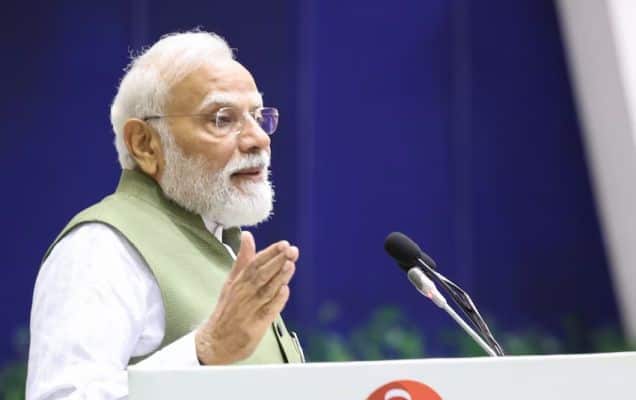
Cabinet Approves RDI Scheme in Strategic and Sunrise Domains

Published By : Admin | July 1, 2025 | 16:59 IST

In a transformative step to bolster India’s research and innovation ecosystem, the Union Cabinet, chaired by Prime Minister Shri Narendra Modi, has today approved the Research Development and Innovation (RDI) Scheme with a corpus of Rs. One lakh Crore.

Recognizing the critical role that the private sector plays in driving innovation and commercializing research the RDI Scheme aims to provide long-term financing or refinancing with long tenors at low or nil interest rates to spur private sector investment in RDI. The scheme has been designed to overcome the constraints and challenges in funding of private sector and seeks to provide growth & risk capital to sunrise and strategic sectors to facilitate innovation, promote adoption of technology and enhance competitiveness. Key objectives of the Scheme are as follows:

a) Encourage the private sector to scale up research, development, and innovation (RDI) in sunrise domains and in other sectors relevant for economic security, strategic purpose, and self-reliance;

b) Finance transformative projects at higher levels of Technology Readiness Levels (TRL)

c) Support acquisition of technologies which are critical or of high strategic importance;

d) Facilitate setting up of a Deep-Tech Fund of Funds.

The Governing Board of Anusandhan National Research Foundation (ANRF), chaired by the Prime Minister, will provide overarching strategic direction to the RDI Scheme. The Executive Council (EC) of ANRF will approve the Scheme’s guidelines, and recommend 2nd level fund managers and scope and type of projects in sunrise sectors. An Empowered Group of Secretaries (EGoS) led by the Cabinet Secretary, will be responsible for approving scheme changes, sectors and types of projects as well as second-level fund managers besides reviewing the performance of the Scheme. The Department of Science and Technology (DST) will serve as the nodal department for implementation of RDI Scheme.

The RDI Scheme will have a two-tiered funding mechanism. At the first level, there will be a Special Purpose Fund (SPF) established within the ANRF, which will act as the custodian of funds. From the SPF funds shall be allocated to a variety of 2nd level fund managers. This will be mainly in the form of long-term concessional loans. The funding to R&D projects by the 2nd level fund managers would normally be in the form of long-term loan at low or nil interest rates. Financing in the form of equity may also be done, especially in case of startups. Contribution to Deep-Tech Fund of Funds (FoF) or any other FoF meant for RDI may also be considered.

By addressing the critical need of private sector for long-term, affordable financing, the RDI Scheme fosters self-reliance and global competitiveness, thereby facilitating a conducive innovation ecosystem for the country as it marches towards Viksit Bharat at 2047.

Explore More
Today, the entire country and entire world is filled with the spirit of Bhagwan Shri Ram: PM Modi at Dhwajarohan Utsav in Ayodhya

Popular Speeches

Today, the entire country and entire world is filled with the spirit of Bhagwan Shri Ram: PM Modi at Dhwajarohan Utsav in Ayodhya
Rolls-Royce joins with HAL at the wheel to make India a major aerospace hub

Media Coverage

Rolls-Royce joins with HAL at the wheel to make India a major aerospace hub
NM on the go

Nm on the go

Always be the first to hear from the PM. Get the App Now!
...
Prime Minister’s visit to the United Arab Emirates
May 15, 2026

Prime Minister Shri Narendra Modi paid an official visit to the United Arab Emirates today. He was received at the airport by His Highness Sheikh Mohammed bin Zayed Al Nahyan, President of the UAE and accorded a ceremonial welcome.

The two Leaders held a series of detailed discussions, during which Prime Minister reaffirmed India’s strong condemnation of the attacks on the UAE, as well as its solidarity with leadership and the people of the UAE. Prime Minister also conveyed India’s clear position in favour of ensuring safe transit passage and unimpeded navigation through the Strait of Hormuz, which is vital for enduring regional peace and stability, as well as energy and food security.

The Leaders also reviewed the entire gamut of bilateral relations and welcomed the deepening of the Comprehensive Strategic Partnership across multiple sectors, including energy, trade, investment, defense, security, fintech, infrastructure, education, culture and people to people ties. They acknowledged the success of the India–UAE Comprehensive Economic Partnership Agreement (CEPA), which has led to bilateral trade scaling new heights.

The two Leaders appreciated the vibrant and growing bilateral energy partnership, with the UAE maintaining its role as an important partner in India’s energy security, including in terms of crude oil, LNG and LPG supplies. The Leaders agreed to promote new initiatives for a comprehensive energy partnership. In this context, they welcomed the conclusion of a Strategic Collaboration Agreement between Indian Strategic Petroleum Reserves Limited and Abu Dhabi National Oil Company to enhance UAE’s participation in India’s Strategic Petroleum Reserves to 30 million barrels, and work together to set up strategic gas reserves in India. They also welcomed the arrangement entered into between Indian Oil Limited (IOCL) Company and Abu Dhabi National Oil Company (ADNOC) on long-term LPG supplies.

The two Leaders welcomed the announcement of USD 5 billion in investment into India by UAE entities. This includes investment of USD 3 billion by the Emirates New Development Bank (ENDB) in the RBL Bank of India, USD 1 billion by the Abu Dhabi Investment Authority (ADIA) with the National Infrastructure & Investment Fund of India (NIIF) in priority infrastructure projects in India, and USD 1 billion by the International Holding Company in Sammaan Capital of India. These investments underscore UAE’s sustained and long-term commitment to India’s growth story, while strengthening the bilateral strategic investment partnership.

The Leaders acknowledged the steady and strong bilateral defence cooperation as an important pillar of the Comprehensive Strategic Partnership. They welcomed the signing of the Framework for the Strategic Defence Partnership between the two countries during the visit. Under this, the two sides have agreed on deepening defence industrial collaboration and cooperation on innovation and advanced technology, training, exercises, maritime security, cyber defence, secure communications and information exchange.

The two Leaders also witnessed the conclusion of the following additional documents during the visit, which will further strengthen bilateral cooperation:

· MoU between Cochin Shipyard Limited and Drydocks World, Dubai on setting up Ship Repair Cluster at Vadinar, including offshore fabrication, under the Maritime Development Fund Scheme launched by the Government of India.

· Tripartite MoU between Cochin Shipyard Limited, the Drydocks World Dubai and Centre of Excellence in Maritime & Shipbuilding (CEMS) on Skill Development in Ship Repair. This establishes a framework to mobilize, train and employ a skilled maritime workforce, enhances the capabilities of the Indian maritime workforce and position India as a hub for skilled shipbuilding and ship repair professionals.

· Term Sheet for setting up 8 Exaflop Super Compute Cluster in partnership between CDAC, India and G-42, UAE.

The two leaders also welcomed the operationalisation of the Virtual Trade Corridor using MAITRI (Master Application for International Trade and Regulatory Interface interface). This digital framework, connecting customs and port authorities on both sides, will streamline cargo movement and reduce both costs and transit time, thereby enabling more efficient trade flows.

Prime Minister thanked President His Highness Sheikh Mohamed bin Zayed Al Nahyan for the warm welcome and gracious hospitality extended to him and invited him to visit India at an early date.