Cabinet approves major Reforms in Telecom Sector

Published By : Admin | September 15, 2021 | 21:22 IST

The Union Cabinet, chaired by the Prime Minister Shri Narendra Modi, today approved a number of structural and process reforms in the Telecom sector. These are expected to protect and generate employment opportunities, promote healthy competition, protect interests of consumers, infuse liquidity, encourage investment and reduce regulatory burden on Telecom Service Providers (TSPs).

In the backdrop of the outstanding performance of the Telecom Sector in meeting COVID-19 challenges, with huge surge in data consumption, online education, work from home, interpersonal connect through social media, virtual meetings etc., the Reform measures will further boost the proliferation and penetration of broadband and telecom connectivity. The Cabinet decision reinforces the Prime Minister’s vision of a robust Telecom Sector. With competition and customer choice, antyodaya for inclusive development and bringing the marginalized areas into the mainstream and universal broadband access to connect the unconnected. The package is also expected to boost 4G proliferation, infuse liquidity and create an enabling environment for investment in 5G networks.

Nine structural reforms and Five procedural reforms plus relief measures for the Telecom Service Providers are as below:

Structural Reforms

  1. Rationalization of Adjusted Gross Revenue:  Non-telecom revenue will be excluded on prospective basis from the definition of AGR.
  2. Bank Guarantees (BGs) rationalized: Huge reduction in BG requirements (80%) against License Fee (LF) and other similar Levies. No requirements for multiple BGs in different Licenced Service Areas (LSAs) regions in the country. Instead, One BG will be enough.
  3. Interest rates rationalized/ Penalties removed: From 1st October, 2021, Delayed payments of License Fee (LF)/Spectrum Usage Charge (SUC) will attract interest rate of SBI’s MCLR plus 2% instead of MCLR plus 4%; interest compounded annually instead of monthly; penalty and interest on penalty removed.
  4. For Auctions held henceforth, no BGs will be required to secure instalment payments. Industry has matured and the past practice of BG is no longer required. 
  5. Spectrum Tenure: In future Auctions, tenure of spectrum increased from 20 to 30 years.
  6. Surrender of spectrum will be permitted after 10 years for spectrum acquired in the future auctions.
  7. No Spectrum Usage Charge (SUC) for spectrum acquired in future spectrum auctions.
  8. Spectrum sharing encouraged- additional SUC of 0.5% for spectrum sharing removed.
  9. To encourage investment, 100% Foreign Direct Investment (FDI) under automatic route permitted in Telecom Sector. All safeguards will apply.

Procedural Reforms

  1. Auction calendar fixed - Spectrum auctions to be normally held in the last quarter of every financial year.
  2. Ease of doing business promoted - cumbersome requirement of licenses under 1953 Customs Notification for wireless equipment removed. Replaced with self-declaration.
  3. Know Your Customers (KYC) reforms: Self-KYC (App based) permitted. E-KYC rate revised to only One Rupee. Shifting from Prepaid to Post-paid and vice-versa will not require fresh KYC.
  4. Paper Customer Acquisition Forms (CAF) will be replaced by digital storage of data. Nearly 300-400 crore paper CAFs lying in various warehouses of TSPs will not be required. Warehouse audit of CAF will not be required.
  5. SACFA clearance for telecom towers eased. DOT will accept data on a portal based on self-declaration basis. Portals of other Agencies (such as Civil Aviation) will be linked with DOT Portal.

Addressing Liquidity requirements of Telecom Service Providers

The Cabinet approved the following for all the Telecom Service Providers (TSPs):

  1. Moratorium/Deferment of upto four years in annual payments of dues arising out of the AGR judgement, with however,  by protecting the Net Present Value (NPV) of the due amounts being protected.
  2. Moratorium/Deferment on due payments of spectrum purchased in past auctions (excluding the auction of 2021) for upto four years with NPV protected at the interest rate stipulated in the respective auctions.
  3. Option to the TSPs to pay the interest amount arising due to the said deferment of payment by way of equity.
  4. At the option of the Government, to convert the due amount pertaining to the said deferred payment by way of equity at the end of the Moratorium/Deferment period, guidelines for which will be finalized by the Ministry of Finance.

The above will be applicable for all TSPs and will provide relief by easing liquidity and cash flow. This will also help various banks having substantial exposure to the Telecom sector.

Explore More
Today, the entire country and entire world is filled with the spirit of Bhagwan Shri Ram: PM Modi at Dhwajarohan Utsav in Ayodhya

Popular Speeches

Today, the entire country and entire world is filled with the spirit of Bhagwan Shri Ram: PM Modi at Dhwajarohan Utsav in Ayodhya
UPI — an eventful journey

Media Coverage

UPI — an eventful journey
NM on the go

Nm on the go

Always be the first to hear from the PM. Get the App Now!
...
PM chairs 53rd PRAGATI Meeting
August 25, 2026
PM reviews six key infrastructure projects across the Railway, Road and Power sectors
Projects reviewed span across 9 States with cumulative investment of more than ₹30,000 crore
PM says Infrastructure projects should be viewed as an integrated whole, rather than as individual sections or packages
PM calls for continuous reforms across all stages of project implementation and a proactive work culture across Ministries and States
PM says Speed must go hand-in-hand with quality
While reviewing AgriStack, PM emphasises the need to leverage the latest digital technologies including AI to derive greater value from agricultural data
On cyber fraud and ‘digital arrest’, PM stresses training, public awareness, cyber-safety education and coordinated action

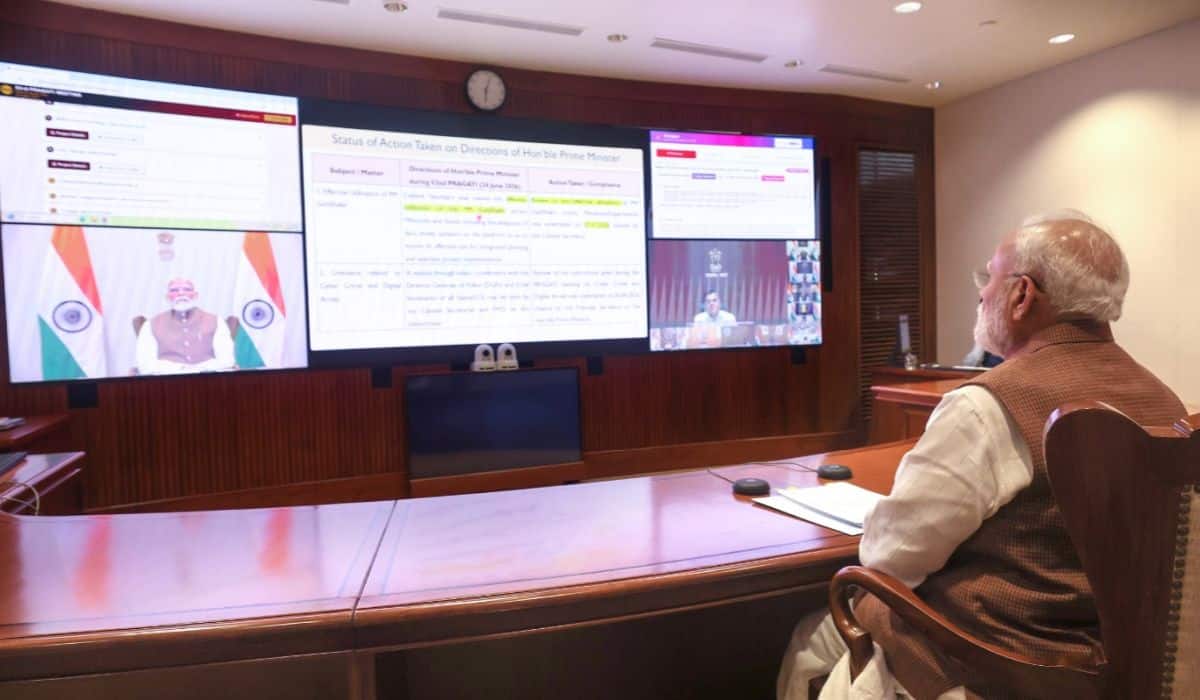
Prime Minister Shri Narendra Modi chaired the 53rd meeting of PRAGATI, the ICT-enabled, multi-modal platform for Pro-Active Governance and Timely Implementation, at Seva Teerth earlier today.

During the meeting, Prime Minister reviewed six key infrastructure projects across the Railway, Road and Power sectors, spanning nine States with a cumulative cost of more than ₹30,000 crore. The projects, significant for strengthening connectivity, supporting industrial and economic activity and improving public services, were reviewed with particular emphasis on adherence to timelines, inter-agency coordination, resolution of pending issues and expeditious completion.

Prime Minister emphasised that delays in infrastructure projects have consequences beyond cost escalation, as they also postpone the benefits intended for citizens, businesses and the economy. He said that infrastructure projects should be viewed and monitored as an integrated whole, rather than as isolated sections, stretches or packages. He noted that progress in individual packages should ultimately translate into timely completion and operationalisation of the entire project. Ministries and States were therefore asked to adopt an end-to-end approach, and address critical gaps that could delay the overall commissioning and delivery of benefits. He called for fostering a proactive work culture across Ministries and State Governments, with greater ownership at every level of project implementation.

Prime Minister stressed the need to explore common utility corridors for infrastructure services, wherever feasible, particularly while planning major transport and infrastructure projects. He called upon Ministries and States to examine such integrated approaches at the planning stage itself, keeping in view their technical and economic feasibility.

Prime Minister said that speed of execution must be accompanied by uncompromising quality. He called upon Ministries, States and implementing agencies to adopt modern technologies and strengthen quality assurance and supervision at every stage.

While reviewing AgriStack under the Digital Agriculture Mission, Prime Minister emphasised the need to leverage the latest digital technologies, including Artificial Intelligence, to derive greater value from agricultural data. He stressed that the data ecosystem should be effectively utilised across the agricultural value chain, from input planning to processing, enabling more informed interventions, better targeting and data-driven decision-making. He appreciated the efforts of the States and the Central Government in building the AgriStack ecosystem and called for further strengthening its use for delivering better outcomes for farmers.

During the review of cyber fraud cases, including incidents of digital arrest, Prime Minister said that prevention must be strengthened through a sustained focus on training, awareness and education. He stressed the need for continuous and targeted public-awareness campaigns, particularly for senior citizens, youth and other vulnerable sections, to familiarise them with common fraud techniques, warning signs and safe digital practices. He also called for regular capacity-building of personnel involved so that emerging modes of cyber fraud are identified and acted upon swiftly.