Bharat – Towards Fostering Cultural Connectivity

Published By : Admin | February 24, 2024 | 17:45 IST

Since assuming office, Prime Minister Narendra Modi has become a catalyst in bringing much-needed change in the cultural sphere, bringing different communities together and imbibing a sense of cultural pride in youth and old alike. There has been an unprecedented push towards the revival of ignored traditions and cultural values and the restoration of connectivity in the form of corridors and infrastructures under the leadership of the PM. The government under PM Modi has delivered on its promises by giving unwavering attention to the revival of our faith and culture by revamping once-neglected pilgrimage places and corridors.

The need for the revival and redevelopment of connectivity is driven by a multitude of factors, such as preserving one's identity and heritage, instil a sense of pride in India's cultural heritage and wisdom, reconnecting with roots, rekindling pride and patriotism, promoting cultural diplomacy, and boosting tourism and the economy.
The government has been making positive strides towards enhancing accessibility to pilgrimage places and corridors by developing infrastructure and encouraging religious tourism, which plays a significant role in creating jobs and upscaling the circular economy. The government has undertaken considerable infrastructure development projects to enhance connectivity, accessibility, and overall quality of life. These initiatives promote tourism, boost economic growth, and address the needs of the rapidly growing population. These infrastructure works collectively contribute to the socio-economic development of the region, making it more resilient, connected, and capable of meeting the needs of its residents and visitors.

In order to transform India into a world-class destination for spiritual tourism, the government under PM Modi has undertaken several redevelopment projects. Tourism initiatives such as the SWADESH DARSHAN and PRASHAD schemes have been taken to promote tourism by developing theme-based circuits.

One of the most notable initiatives is the PRASHAD scheme, which the Indian government launched through the Ministry of Tourism in 2014–2015. PRASHAD scheme stands for Pilgrimage Rejuvenation And Spiritual Augmentation Drive. This project focuses on establishing and identifying pilgrimage sites around India to boost the religious tourist experience. It strives to integrate pilgrimage places in a prioritised, planned and sustainable manner to deliver a holistic religious tourism experience.
The PRASHAD program aims to facilitate the growth and advancement of religious tourism in India. The main goal of the scheme is to improve pilgrimages and spiritual experiences for visitors by providing well-planned tourism infrastructure that allows for visitor comfort, accessibility, security, and cleanliness. To rejuvenate pilgrimages and heritage cities by preserving their souls through integrated, inclusive, and sustainable development that creates jobs for the local population.

Under the PRASHAD scheme, the Ministry offers financial support to Union Territory Administrations and State Governments to construct infrastructure at tourist attractions. The Ministry has approved 46 projects totalling Rs. 1629.17 crore to date. Furthermore, 26 additional locations have been identified for development under the PRASHAD Scheme.

While heritage cities are chosen based on their high heritage values, tourist traffic, number of monuments, and accreditations, pilgrimage destinations are selected based on pilgrimage lineage and pilgrim footfall.

From investing in infrastructural works, be it Roadways or Ropeways, or enhancing the connectivity through Char Dham Projects, the government has left no stone unturned to connect the once inaccessible terrains to the masses. This includes constructing and widening highways, bridges, and rural roads. Efforts have also been made to enhance and improve rail and air connectivity in Uttarakhand.

With the government embarking on this marvellous journey of restoring the lost glory to once forgotten cultural heritage and traditions, the people of the nation are getting connected to their roots again. Along with bringing an overhaul in the cultural and heritage development, the government has been successful in the revival of not just our traditions, heritage, and culture but also the creation of infrastructural landmarks and marvels simultaneously. Today, not only are the nation's citizens in awe of their restored cultural heritage, but Bharat, triumphantly, has managed to put herself on the global cultural pedestal where the whole world is taking note of her ever-evolving nature.

Explore More
Today, the entire country and entire world is filled with the spirit of Bhagwan Shri Ram: PM Modi at Dhwajarohan Utsav in Ayodhya

Popular Speeches

Today, the entire country and entire world is filled with the spirit of Bhagwan Shri Ram: PM Modi at Dhwajarohan Utsav in Ayodhya
India's electronics exports cross $47 billion in 2025 on iPhone push

Media Coverage

India's electronics exports cross $47 billion in 2025 on iPhone push
NM on the go

Nm on the go

Always be the first to hear from the PM. Get the App Now!
...
6 Years of Jal Jeevan Mission: Transforming Lives, One Tap at a Time
August 14, 2025
Jal Jeevan Mission has become a major development parameter to provide water to every household.” - PM Narendra Modi

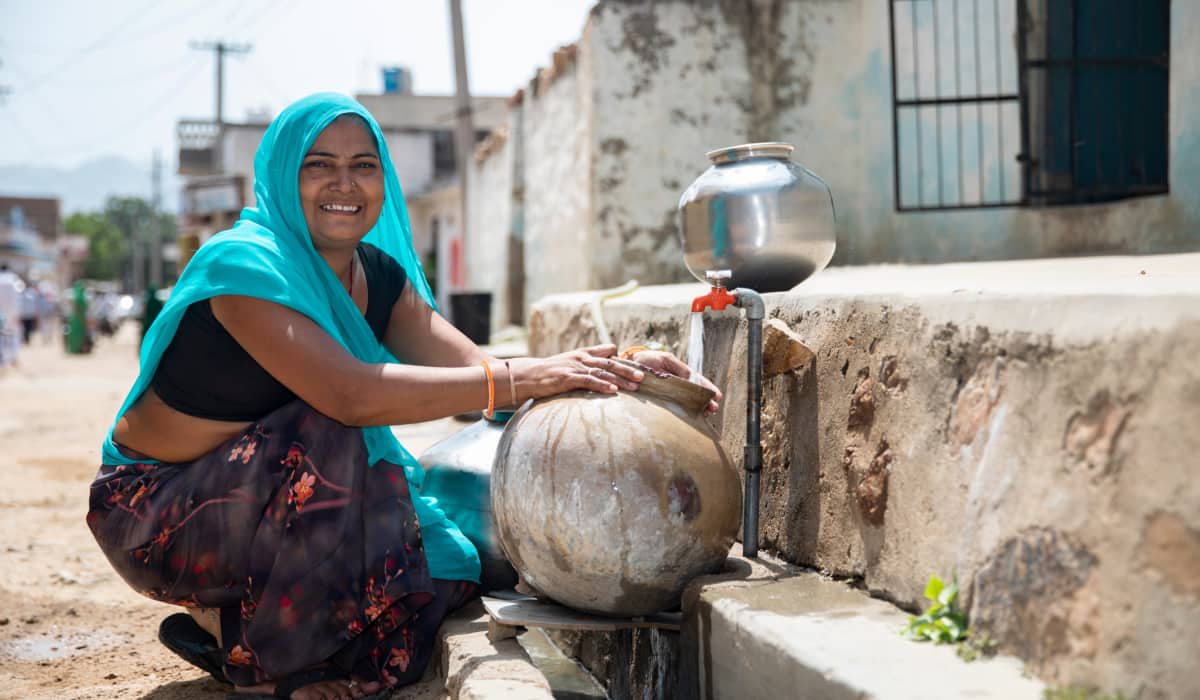
For generations, the sight of women carrying pots of water on their heads was an everyday scene in rural India. It was more than a chore, it was a necessity that was an integral part of their everyday life. The water was brought back, often just one or two pots which had to be stretched for drinking, cooking, cleaning, and washing. It was a routine that left little time for rest, education, or income-generating work, and the burden fell most heavily on women.

Before 2014 water scarcity, one of India’s most pressing problems, was met with little urgency or vision. Access to safe drinking water was fragmented, villages relied on distant sources, and nationwide household tap connections were seen as unrealistic.

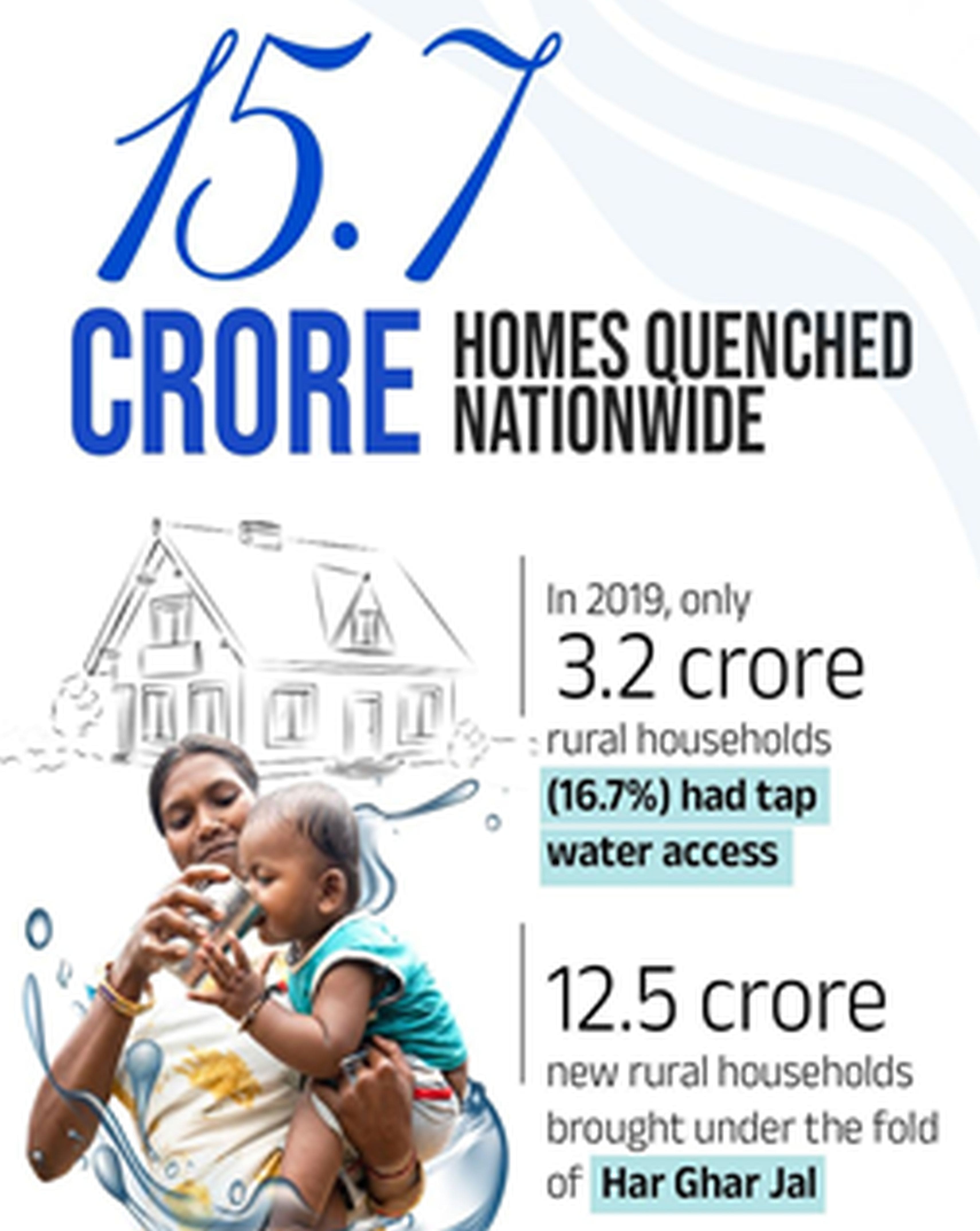
This reality began to shift in 2019, when the Government of India launched the Jal Jeevan Mission (JJM). A centrally sponsored initiative which aims at providing a Functional Household Tap Connection (FHTC) to every rural household. At that time, only 3.2 crore rural households, a modest 16.7% of the total, had tap water. The rest still depended on community sources, often far from home.

As of July 2025, the progress under the Har Ghar Jal program has been exceptional, with 12.5 crore additional rural households connected, bringing the total to over 15.7 crore. The program has achieved 100% tap water coverage in 200 districts and over 2.6 lakh villages, with 8 states and 3 union territories now fully covered. For millions, this means not just access to water at home, but saved time, improved health, and restored dignity. Nearly 80% of tap water coverage has been achieved in 112 aspirational districts, a significant rise from less than 8%. Additionally, 59 lakh households in LWE districts have gained tap water connections, ensuring development reaches every corner. Acknowledging both the significant progress and the road ahead, the Union Budget 2025–26 announced the program’s extension until 2028 with an increased budget.

The Jal Jeevan Mission, launched nationally in 2019, traces its origins to Gujarat, where Narendra Modi, as Chief Minister, tackled water scarcity in the arid state through the Sujalam Sufalam initiative. This effort formed a blueprint for a mission that would one day aim to provide tap water to every rural household in India.

Though drinking water is a State subject, the Government of India has taken on the role of a committed partner, providing technical and financial support while empowering States to plan and implement local solutions. To keep the Mission on track, a strong monitoring system links Aadhaar for targeting, geo-tags assets, conducts third-party inspections, and uses IoT devices to track village water flow.

The Jal Jeevan Mission’s objectives are as much about people as they are about pipes. By prioritizing underserved and water-stressed areas, ensuring that schools, Anganwadi centres, and health facilities have running water, and encouraging local communities to take ownership through contributions or shramdaan, the Mission aims to make safe water everyone’s responsibility..

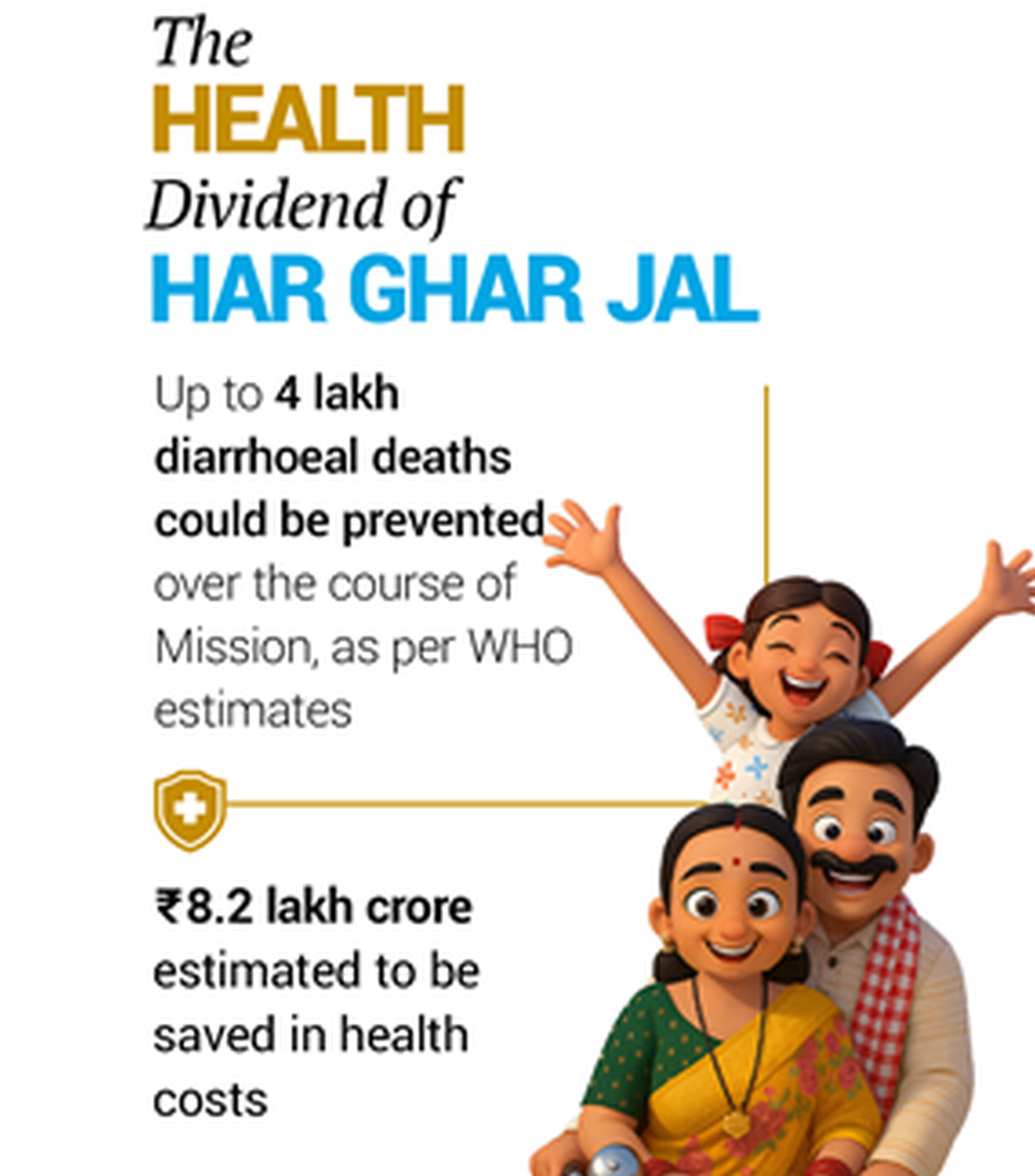
The impact reaches far beyond convenience. The World Health Organization estimates that achieving JJM’s targets could save over 5.5 crore hours each day, time that can now be spent on education, work, or family. 9 crore women no longer need to fetch water from outside. WHO also projects that safe water for all could prevent nearly 4 lakh deaths from diarrhoeal disease and save Rs. 8.2 lakh crores in health costs. Additionally, according to IIM Bangalore and the International Labour Organization, JJM has generated nearly 3 crore person-years of employment during its build-out, with nearly 25 lakh women are trained to use Field testing Kits.

From the quiet relief of a mother filling a glass of clean water in her kitchen, to the confidence of a school where children can drink without worry, the Jal Jeevan Mission is changing what it means to live in rural India.