Augmenting the local strengths of North East

Published By : Admin | March 14, 2019 | 14:46 IST

It is well known that Northeast has largely remained out of the direct sphere of governance due to the oft-repeated reason of ‘tyranny of distance’. However, Modi government has brought the focus of the central government and rest of the nation on the innumerable opportunities arising due to the development of the region. It has laid a solid foundation in the region to fulfill the aspiration of the people. 

The government is working on multiple fronts to bring the region at the same level of development as the rest of the country. It has been able to successful complete long-standing infrastructural projects as well fulfill demands of the people of the region in the last 5 years. 

Accelerated Pace of Infrastructural Growth 

The pace of infrastructural growth is changing the face of the northeastern region. Engineering marvels like one of the five highest airports in the country - Pakyong airport, India’s longest bridge – DholaSadiya bridge, India's largest railroad bridge - Bogibeel Bridge, have been successfully made operational for the benefit of North-East region’s economy as well deepen connectivity. 

The government has initiated the construction of a new AIIMS in Guwahati with a cost of more than Rs. 1,100 Crores, thus, bringing tertiary healthcare facilities nearby.  In order to connect the North East with a national gas grid, a gas pipeline up to Guwahati is being laid by GAIL at a cost of Rs. 3,000 Crores. 

More Power to the Northeast 

Ensuring power for every village and every household has benefited the Northeast tremendously. In the last five years, 6000 villages and around13 lakh households in the northeast have been electrified. Recently, Mizoram became the 3rd power surplus state in the Northeast Region (NER) after Sikkim and Tripura. The North-East region is now experiencing ‘Transformation by Development’. 

Boost to the Local Ts: Textiles, Trade and Tourism 

India’s Northeast is blessed with great cultural diversity, especially in terms of textiles. For the first time ever North East Investors’ Summit was held in Shillong, especially focused to promote the textile industry and allied sectors. 

Development and modernization of the textile sector in the Northeastern states will create more jobs, especially for women of that region. Each apparel and garment manufacturing centre under the North East Region Textile Scheme is employing around 1,200 people.

The region is being developed as a trade and tourism hub, with India’s ‘Act East Policy’ in focus. Access to sea via Bangladesh and Myanmar is beneficial for the economy of the landlocked northeast. The India-Myanmar-Thailand Trilateral Highway has opened the ASEAN market through seamless passenger and freight movement.

The Buddhist tourism circuit from East India begins from Bihar and traverse through many Northeastern states into the nations of Southeast Asia. Accordingly, a favorable ecosystem has been put in place. This initiative carries the potential of becoming a significant contributor in advancing tourism sector in the region.

Boost to Bamboo Farming

Bamboo is central to the rural economy of the northeast. Its classification as tree meant various restrictions to produce, transport, and sale. In order to boost the local economy, the government re-classified bamboo from ‘tree’ to ‘grass’. It has led to free movement of bamboo products, encourages bamboo plantation and boosts farmers’ income.

Strengthening the Organic Farming Sector

India’s northeast is an organic farming hub. The necessary support from the government is ensuring that it continues to become a model of sustainable agriculture for the nation and the world. The Paramparagat Krishi Vikas Yojana has brought around 45,000 hectares of land under organic farming. Further, an organic value chain is being developed with support for a gamut of services including seeds, certification, aggregation, processing, marketing and brand building.

There is a lot of enthusiasm among the people of northeastern states with the manner in which a new northeast is being developed with the sustained efforts in various sectors. A new northeast seems is emerging that is gearing to lead India’s development journey.

Explore More
Today, the entire country and entire world is filled with the spirit of Bhagwan Shri Ram: PM Modi at Dhwajarohan Utsav in Ayodhya

Popular Speeches

Today, the entire country and entire world is filled with the spirit of Bhagwan Shri Ram: PM Modi at Dhwajarohan Utsav in Ayodhya
India remains fastest-growing major economy, domestic investors power market resilience

Media Coverage

India remains fastest-growing major economy, domestic investors power market resilience
NM on the go

Nm on the go

Always be the first to hear from the PM. Get the App Now!
...
6 Years of Jal Jeevan Mission: Transforming Lives, One Tap at a Time
August 14, 2025
Jal Jeevan Mission has become a major development parameter to provide water to every household.” - PM Narendra Modi

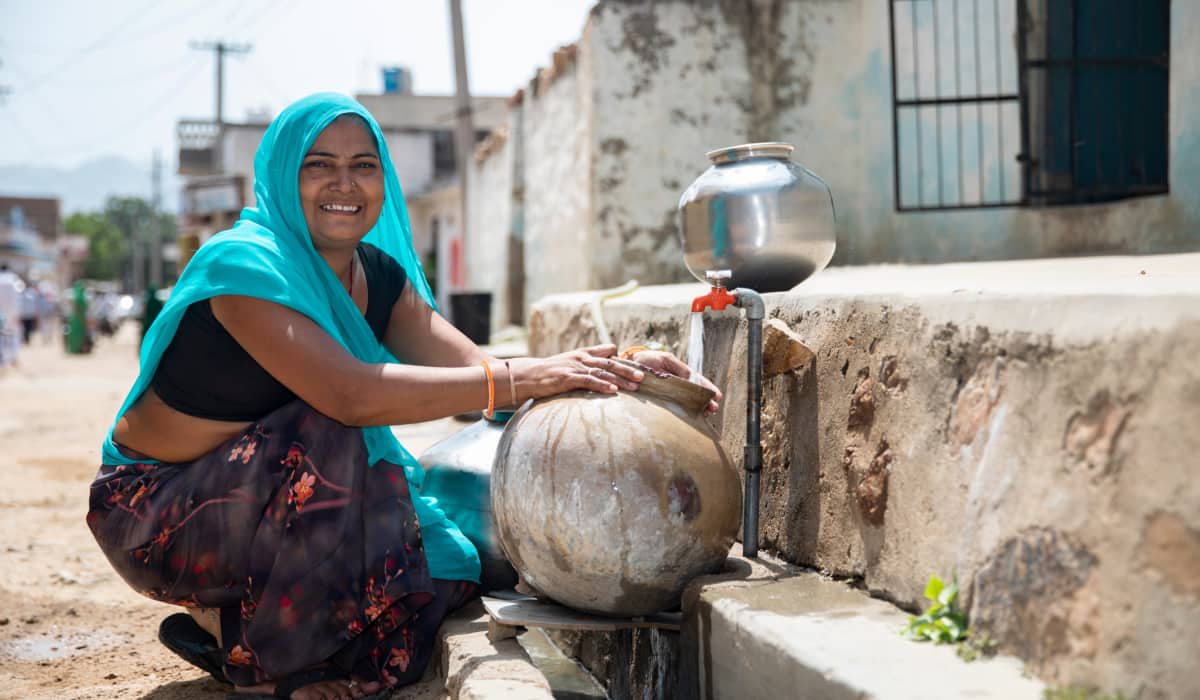
For generations, the sight of women carrying pots of water on their heads was an everyday scene in rural India. It was more than a chore, it was a necessity that was an integral part of their everyday life. The water was brought back, often just one or two pots which had to be stretched for drinking, cooking, cleaning, and washing. It was a routine that left little time for rest, education, or income-generating work, and the burden fell most heavily on women.

Before 2014 water scarcity, one of India’s most pressing problems, was met with little urgency or vision. Access to safe drinking water was fragmented, villages relied on distant sources, and nationwide household tap connections were seen as unrealistic.

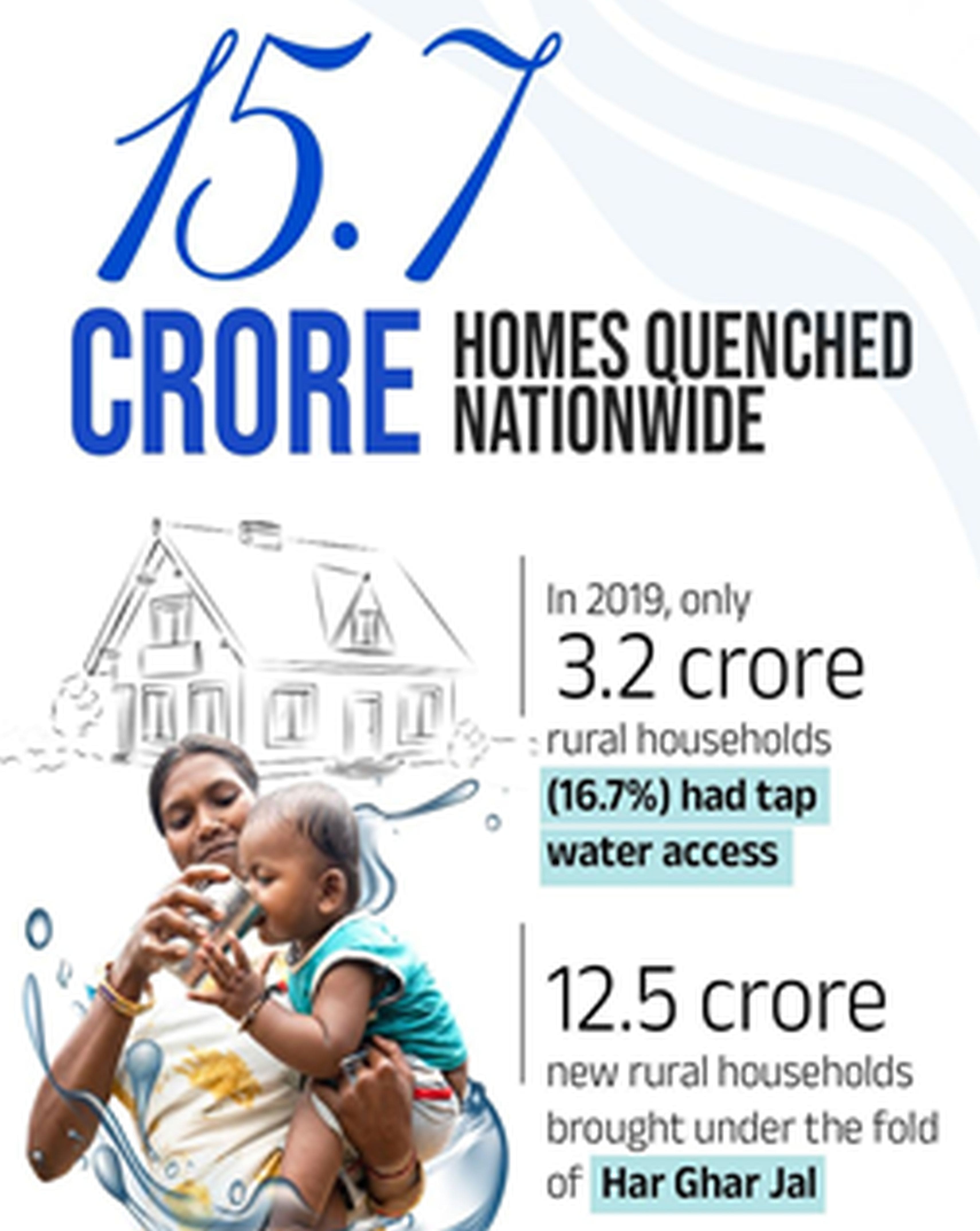
This reality began to shift in 2019, when the Government of India launched the Jal Jeevan Mission (JJM). A centrally sponsored initiative which aims at providing a Functional Household Tap Connection (FHTC) to every rural household. At that time, only 3.2 crore rural households, a modest 16.7% of the total, had tap water. The rest still depended on community sources, often far from home.

As of July 2025, the progress under the Har Ghar Jal program has been exceptional, with 12.5 crore additional rural households connected, bringing the total to over 15.7 crore. The program has achieved 100% tap water coverage in 200 districts and over 2.6 lakh villages, with 8 states and 3 union territories now fully covered. For millions, this means not just access to water at home, but saved time, improved health, and restored dignity. Nearly 80% of tap water coverage has been achieved in 112 aspirational districts, a significant rise from less than 8%. Additionally, 59 lakh households in LWE districts have gained tap water connections, ensuring development reaches every corner. Acknowledging both the significant progress and the road ahead, the Union Budget 2025–26 announced the program’s extension until 2028 with an increased budget.

The Jal Jeevan Mission, launched nationally in 2019, traces its origins to Gujarat, where Narendra Modi, as Chief Minister, tackled water scarcity in the arid state through the Sujalam Sufalam initiative. This effort formed a blueprint for a mission that would one day aim to provide tap water to every rural household in India.

Though drinking water is a State subject, the Government of India has taken on the role of a committed partner, providing technical and financial support while empowering States to plan and implement local solutions. To keep the Mission on track, a strong monitoring system links Aadhaar for targeting, geo-tags assets, conducts third-party inspections, and uses IoT devices to track village water flow.

The Jal Jeevan Mission’s objectives are as much about people as they are about pipes. By prioritizing underserved and water-stressed areas, ensuring that schools, Anganwadi centres, and health facilities have running water, and encouraging local communities to take ownership through contributions or shramdaan, the Mission aims to make safe water everyone’s responsibility..

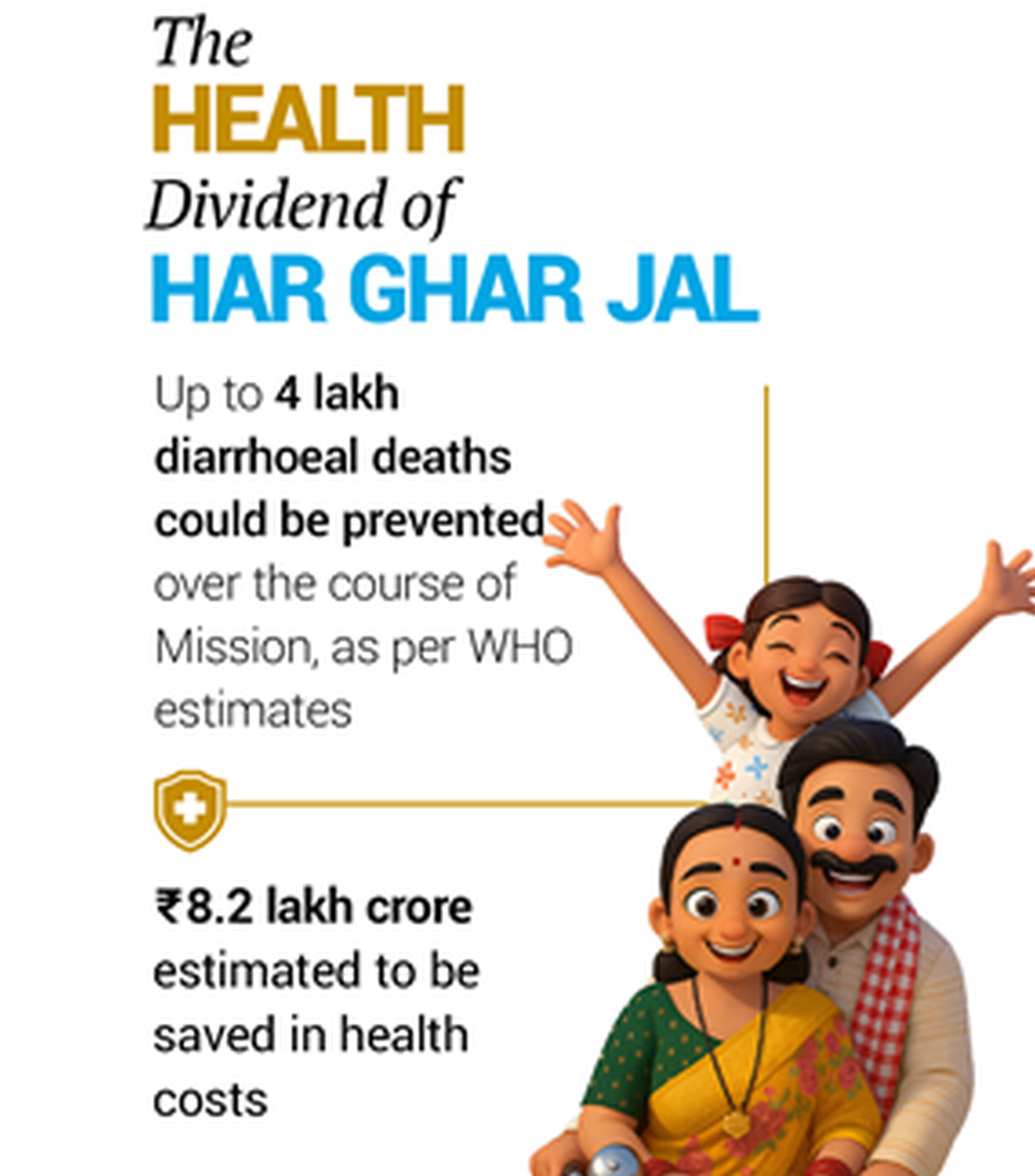
The impact reaches far beyond convenience. The World Health Organization estimates that achieving JJM’s targets could save over 5.5 crore hours each day, time that can now be spent on education, work, or family. 9 crore women no longer need to fetch water from outside. WHO also projects that safe water for all could prevent nearly 4 lakh deaths from diarrhoeal disease and save Rs. 8.2 lakh crores in health costs. Additionally, according to IIM Bangalore and the International Labour Organization, JJM has generated nearly 3 crore person-years of employment during its build-out, with nearly 25 lakh women are trained to use Field testing Kits.

From the quiet relief of a mother filling a glass of clean water in her kitchen, to the confidence of a school where children can drink without worry, the Jal Jeevan Mission is changing what it means to live in rural India.