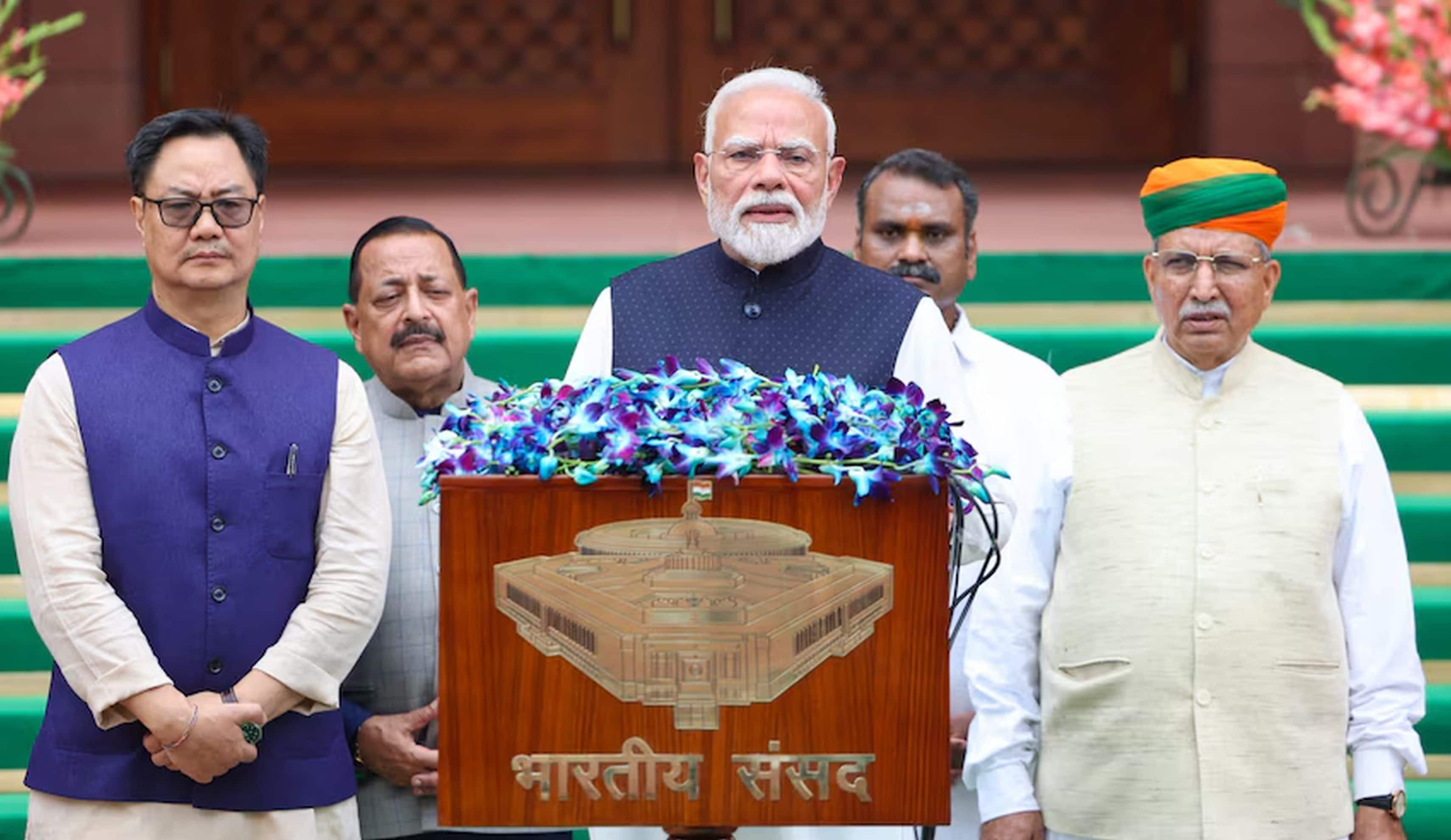
Place : Mumbai Speech Date :5-06-2010
- Mere good governance is not enough; it has to be pro-people and pro-active. Good governance is putting people at the centre of development process.
- For achieving good governance political will is necessary. Good governance is a political process. Though role of civil society is critical, without political will and political process sustainable good governance cannot be achieved.
- People's participation is the essence of good governance.
- Good Governance cannot remain merely a philosophy. Concrete steps have to be taken for realizing its goals.
- Good governance is not fire-fighting or crisis-management. Instead of opting for ad hoc solutions the need of the hour is to tackle the root cause of the problems.
- Team Work is the essence of good governance. It is necessary to form a team within the party and also within the administrative system.
- Good governance needs self-discipline. Only discipline within can ensure discipline without.
Dear Friends,
You have requested me to talk on a topic which is close to my heart. Today I have been asked to talk on a topic in which I am not an authority. But years of my association with organizational activities particularly management of human resources, management of the organization, motivation, coordination and planning on every day basis has helped me. My experience is useful in handling the activities of the government. When compared with the organizational activity, now there is a wider canvas for me to implement good governance. This shows that those who are involved in activities that are creative and useful to the society have an edge over others for understanding and implementing good governance.
I stand before you to share some of my experiences and thoughts with the hope that they will contribute to increasing the efficiency of the governments. While I say this I am aware that every State under the leadership of my fellow Chief Ministers and those guiding the party have experiences to share and worth emulating. By no means therefore, this is an effort to say that Gujarat monopolized the initiatives and innovations. My effort is to share my experience so that it can initiate the thought process towards innovations.
The topic is not simply good governance, but about democratic governance. The very assumption behind democratic governance is that it will provide good governance. The free press, media, and elections would help better governance. Good governance may be there even in authoritarian regimes, but it may not be democratic. Democratic governance should empower people. It should put people at the centre of development process. Democratic governance means people should not only own the product but also own the process. Thus one can say democratic governance includes good governance but at the same time it goes beyond good governance to ensure that the very process is people driven. But at the same time good governance is also seen as an enabling factor for functioning of democratic systems that include freedom of expression and independent judiciary.
Modern Mantra
First let us look at good governance. Good governance is the modern mantra of development agencies. It has become a fashionable word in development circles, among activists, international funding agencies like World Bank, UN agencies and even in press and media. The fact that in party meetings we discuss about good governance really shows that it has come of age. It should no longer remain a buzz word, an inevitable phrase to be included in the funding proposals, but a political reality. In the literature on good governance we see mainly discourses which try to portray as if good governance is apolitical. But good governance cannot be apolitical. It cannot be achieved without political parties realizing the need for good governance and make it part of their manifesto. Hence I have to congratulate the organizers for recognizing this fact.
Is good governance new to us? ‘Suraj' (Good Governance) or 'Sushashan' (good administration) is not new to us as we Indians have been hearing the concept of ‘Ram Rajya' since our childhood days. Barthwal says that the concept of Ram Rajya and the advice given by Lord Krishan to Arjuna in Gita is only about good governance. In fact as he rightly points out some of these are embedded in our Constitution itself. Hence the question here is not about what good governance is but how to achieve it? What are the challenges and issues? However, Suraj has come to mean different things to different people; and we need to focus and understand it right so that unless we see its significance it is difficult either to fix people-oriented goals or bring in about a change for the betterment of our people. It is the poor who are badly hit.
The Good Governance is the ability to differentiate between right and wrong, just and unjust, fair and foul and moral and immoral. Kautilya in his Arthashastra says that in order to ensure this the person who governs should understand that his happiness lies in the happiness of his subjects, his welfare in their welfare. He adds, he will not consider whatever pleases him as good, but will consider what is good for their subjects as good. But this in itself does not make it democratic governance. But in the context of democratic good governance, people are no longer subjects but are participants. This explains the concept of Governance which includes all the stakeholders: legislature, judiciary, executive, private sector, civil society and the citizens. Governance transcends files and procedures of a government.
Good governance is very difficult to define. For some it is securing justice, empowerment, employment and efficient delivery of services. Some even define good governance as the relation between market, state and civil society. You can talk about several key components of the same like rule of law, accountability, transparency, equity, respect for human rights and dignity. According to ADB the four key components of good governance are: Accountability, Transparency, Predictability and Participation. According to World Bank good governance means public sector management, accountability, legal framework, and information and transparency as the key components of good governance. According to Department of International Development good governance is centered upon three main concepts: 1. State Capability 2. Accountability and 3. Responsiveness.
Key Components
All those who talk about good governance broadly agree on the following as the key components of good governance
1. Accountability both political and bureaucratic
2. Participation of various stakeholders in the decision-making process
3. Rule of law
4. Transparency and freedom of information
5. Responsive
6. Equitable and inclusive
7. Effective and efficient administration
8. Robust grievance redress mechanisms
Good governance is the cause as well as effect of these contributing factors. Sometimes when I read about the discussion on good governance it appears like the chicken and egg story. Which comes first? Does good governance creates all the above, or all the above create good governance. The question is if there is no good governance, then how to bring about it? This is the main point of difference between political parties and international funding agencies and NGOs. IFAs and NGOs think that it can be brought about mainly through the civil society, and NGOs. But though the role of civil society is critical, can it be achieved without political processes and political will? Can it be sustainable without political parties recognizing the need for good governance? Even through projects, external funding and aid such good governance is achieved will it be sustainable and permanent? Hence this discussion becomes very important.
The concept of good governance is usually associated with the task of running a government or tackling the day-to-day business of government by its executive branch. But here we are assembled to discuss “Suraj Sankalp” and to understand the broader meaning of the term. ‘Suraj' which obviously means which is done to secure the welfare of all and involves interaction of all branches of government with that of civil society in a manner that is just and without discrimination. It is the proper use of political power for the larger good of society which impacts on public life leading to genuine social upliftment.
Ability to rule in a fair and judicious manner depends on certain qualities that cannot be compromised for the public good and this as a concept has been misunderstood. We therefore need to understand, perceive and differentiate between what we are led to believe is good governance and what exactly that the good governance exemplifies. Let there be no doubt that we must first understand good governance before we can think of meeting challenges of tomorrow successfully. If we are really concerned with the future generation, for their sake let us bring about a change through Good Governance.
It is generally thought that good governance is bad politics. Due to this, people who work in political field also think that it is difficult to achieve good governance. We have to come out of this mentality. We should think that good governance is good politics. Governments do a lot but only keeping in mind the next election. The first condition for ensuring good governance is winning hearts in the present than winning votes in future.
Improving human resources, education, security, and standard of life are some of the things which can help good governance. My own philosophy of Panchamurt is the basis of good governance. We focus on Gyan Shakti, Raksha Shakti, and Janshakti which can help good governance. The school enrolment program or the Kanya Kelvani drives etc aim at empowering people, particularly women. I mention them as these are unique initiatives of Government of Gujarat.
Landmark Steps
Some of the steps which have been taken towards equity are convergence of the programs like Garib Kalyan. Here again I have taken pains to eliminate middlemen to hand over the benefits to the poor throughout the length and breadth of Gujarat. “Garib Kalyan Mela” which aims at convergent scheme for eradication of poverty is a pro-active pro-people initiative. Government went to the doorsteps of the beneficiaries. The experiment turned out to be a great success with over 21 lakh poor beneficiaries received Rs 2700 crore worth of benefits through various schemes ranging from housing plot to livelihood kits. The entire scheme was implemented in a totally transparent manner with names of beneficiaries displayed in villages. People were empowered to complain if poor quality assets were given to them.
People's participation is not simply a component of good governance but the main aspect of democratic good governance. We aim for three types of partnerships.
1. Government-Citizen partnerships
2. Public-Private Partnerships
3. Public-Public partnerships
In Gujarat I have ensured people's participation in all developmental schemes. It is not just participation by giving consent or participation through consultation but I have actually made them partners in implementation process. For example, after the earthquake of 2001 in Gujarat, all the primary schools were repaired by the Village Education Committee. Money was handed over to them and they undertook the repairs. Owner-driven reconstruction undertaken in Gujarat after earthquake is another example of Government-Citizen partnerships. For the first time in the country the earthquake-affected people were provided financial, technical and material help to enable them to undertake reconstruction by themselves. They were allowed to choose the site, the design, material and were also allowed to construct according to their needs. No wonder that Gujarat earthquake reconstruction became one of the shining examples of participatory reconstruction process. Participatory irrigation management, joint forest management etc are examples of public-citizens partnership in governance.
Chiranjeevi Scheme which won many awards including the Asian Innovation Award in Singapore in 2006 is an example of Public-private partnership. Private hospitals and doctors participating in enabling institutional delivery is the highlight of the scheme.
In Gujarat, in order to improve human resources V[Vibrant] -governance training program was launched to train all government employees in a phased manner. This program, which aimed to transform Karmacharis into Karmayogis, so far has been able to train lakhs of employees to become the largest capacity-building exercise undertaken by any State Government in the country. Another important aspect of improving our human resources is the annual Chintan Shibir held for IAS officers. These Chinthan Shibirs which began in 2003 have become brainstorming sessions for self-analysis and in evolving many administrative reforms and innovations.
The alarming growth of insurgency and terrorism within the country and instability in neighbouring countries demand clear-thinking on the part of political class. What we need is a strong government. Even in coalition governments if proper leadership is there and we can achieve good governance and take strong steps against forces that work for destabilizing the nation. Accountability as we all agree is one of the key components of good governance. In a democratic set up the government is accountable to the people. But there are various faces to it. One is the accountability of the politically elected executives and legislature. The system of election takes care of it. Political leaders have to face people once in five years. In many places where coalition governments face elections much before their five year term gets completed. Thus there is accountability inbuilt in the very democratic process. Amartya Sen argues that democratic countries with elections and free press manage drought much better than authoritarian regimes. But to make it more robust depends on the political parties. Second is the accountability of bureaucracy. Systems and procedures are in place to ensure this but many may feel that it is in sufficient and ineffective. Making bureaucracy accountable depends on the political will to a large extent. Third is the accountability of non- state actors such as NGOs, and voluntary agencies and activists. This is a grey area. They are said to be watchdogs. But who will watch the watchdogs? A system should be put in place to ensure the transparency and accountability of the NGOs. Once again the accountability of the private institutions in the larger context of environmental protection and welfare of the communities are also real challenges.
Re-look at Accountability
Another issue regarding accountability is ensuring accountability for omissions. Our system is designed to make commission of mistakes accountable and if someone does wrong willfully then he is held accountable. But if someone is guilty of omission or fails to do something what he is supposed to do it is difficult to fix responsibility on him/her. Thus the system encourages people to be indecisive and avoid responsibility rather than those who take bold decisions in the interest of governance. Hence there is need to change the way we look at accountability. Currently the accountability we have is procedural accountability, not performance accountability. The audit we have in place is procedural audit not performance audit. If you do the procedures right and if the performance is poor you get away with it. But in reality performance should be considered more important then procedures and paper work. The challenge is how do you ensure such a system is put in place?
When we discuss about participation of people again there are many dimensions to it. Is it merely consultation, or is it consent or actual participation in decision-making or implementation? What is the lowest unit of consultation? Is it the village, community or household? How do you ensure participation if there is conflict of interest among the villagers or communities? How to arrive at consensus, how long one should wait till such a consensus emerges?
As Robert Putnam points out social capital may play a big role in ensuring good governance. Putnam points out in his path-breaking study, “Making Democracy Work” demonstrates how social capital has played an important role in improving governance in one portion of Italy when compared with the other where such social capital did not exist. However, in the Indian context, we need to consciously build social capital on the basis of professional and civil society interest going beyond mere caste associations. It is a challenge for us.
Media plays an important role in ensuring good governance. While media is willing to expose the failures, it should also highlight the successful initiatives for others to learn lessons and also to encourage those who innovate and perform well amid several constraints.
Frequent transfer of civil servants and officers is considered as one of the impediments of good governance. During my period as Chief Minister I have consciously adopted a policy of minimum transfers so that officers and civil servants can understand their task, innovate and also implement the solutions they think about. Many a times transfer in government is a big industry. But we should understand that by transferring a problematic employee , we do not transfer a person but a problem from one place to the other. So in this context we should use democratic methods to motivate him, make him target oriented and help him if he has any problems.
Transparent systems would automatically reduce corruption to a large extent. Right to Information Act is one of the important initiatives undertaken in this regard. However the act is more often used by middlemen and vested interests to harass administration rather than by the genuine and needy. The challenge is how to provide empowerment without making the system weak? RTI act provides information on the decisions taken, schemes implemented. But my emphasis is more on the procedures which can even make RTI Act redundant. Can you be transparent in procedures, open in the way of functioning, involve the stakeholders in the decision-making process, consult the public at large so that the need for seeking information through RTI itself becomes minimal? However there is a danger of litigations, court stay orders and vested interests delaying the decisions and thwarting the process of governance. This is again a challenge, to evolve a system which takes care of transparency without diluting the efficiency of the government. Herein comes the concept of openness in governance.
Though transparency and openness appear to be the same, in the context of governance they are very different concepts. Transparency is about letting people know what government is doing. It is about providing information what government has done, is doing and intends to do. In short transparency is letting people know the decisions made and decision-making process. But openness is involving the people, the stakeholders in the decision-making process. They have a role in the decision-making process. Thus openness can lead to people's participation. This openness is the very foundation of democratic governance. Transparency is right to information but openness is right to participation. Good governance and collective thinking are synonymous. Thus openness leads to participation and participation leads to collective thinking. Collective thinking helps in fine-tuning the state administrative machinery towards the socio-political changes that reflects the way leaders exercise their power in the pursuit of people's welfare.
Beyond the files
Good governance goes beyond the file to look at life. Real problems are not in government files and hence real solutions should be sought in life which simply means that good governance cannot reside in ivory towers and air-conditioned meeting rooms. It happens in rural areas, where solutions co-exist with the problems but escapes the eyes of those in ivory towers. Hence I insist on collective thinking, openness in administration and people's participation as the basis of good governance.
I have tried an experiment in Gujarat. Technology can be used as a tool for transparency and Information technology can be effectively used to inform and empower people so that good governance is ensured. Government of Gujarat has taken many initiatives in this respect. Swagat online grievance redress system, e gram, computerization of land records, are some of the initiatives which can be cited. As Hellstorm's research indicates even mobile phones can be effectively used for good governance. In fact mobile phones, particularly SMS, was effectively used in Gujarat during floods in 2006 to evacuate tens and thousands of people thus saving precious lives. The greatest thinker of the current century Alvin Toffler has said that technology will penetrate every field of activity. Those who adopt shall prosper; those who do not shall disappear like Dinosaurs. Gujarat has one of the largest civilian e-network in the world fanning 18000 plus villages. This network is being used as a tool for good governance. It is an information highway on one hand connecting the primary school children, health workers, panchayat functionaries and farmers. On the other hand it has also created several facilities and conveniences. For example, earlier a farmer had to spend a lot of time paying his electricity bill at a particular centre. First the post office network was brought in as collection centers and now the e-network in the village can help them settle the bills at their door steps. Soon teleservice to farmers would similarly become available.
In particular I wish to dwell upon SWGAT online grievance redress system that helps common people to meet me and seek redressal of their grievances once a month. There is three-tier grievance redress system in Gujarat: Taluka, District and State level. The grievances brought before the Taluka and District level are reviewed by the Chief Minister. The review is done based on the problems solved and not on the petition disposed. In the state level program where Chief Minister hears the petitioners personally, all the
state level officers remain present. The district level officers assemble in the respective districts and they are linked through video-conferencing. The applicant's grievance is discussed and relevant solutions are found or orders given and the same are followed up in subsequent programs. Thus such an access to highest authority can also reduce corruption and improve efficiency to a large extent. Many other states have studied this program and some of them have already implemented this program.
Without good governance the government machinery is bound to decay and decay it will. It will fail to ensure inclusive growth and gender equality and would be a dampener for women's participation in decision-making at all levels even as women in India are now coming to the forefront. To alleviate poverty civil society organizations needs to work closely with governments and the private sector to help the poor in accessing the fruits of development. Good governance is therefore the glue that holds the political masters, government machinery and the civil society together.
Establishment & Downsizing
There is so much talk about downsizing the government. But this talk about downsizing the Establishment has to be understood in the right sense. In fact I would use the word rightsizing the government. This is not simply mindlessly cutting down the size of the government machinery. Increasing population, rising levels of expectation of people, complexities of administration, specialized aspects of governance need more people for administration. For example in the face of rising level of terrorism, insurgency and violence how can you downsize police force? But at the same time we should be able to use technology modernization so that there is no unnecessary upsizing the Establishment. Another way to maintain the right size is to understand the changing role of the government from being a provider to facilitator and go for a private-public partnership model and public-citizen partnership models.
Mere Good governance is not enough as it needs to be strongly pro-people. What we need is pro-active good governance and the ability to anticipate things and events in advance and take appropriate action. For instance one need to understand the fallout of global warming and what it can do to the state, say 50 or 100 years hence. Climate change may result in global warming, change in rainfall patterns and may also result in hydro meteorological disasters. Temperature rise may result in change in disease patterns also. Such an understanding will help us prevent catastrophes in future. I can give you another example. If after 25 years clean technology is going to be the norm, then we should orient our research towards that. We should have Human Resource Development policies, R&D etc. which should be geared towards meeting the challenge after 25 years.
Pro-active good governance should lead to advance planning and preventive action. For example, if monsoon sets in June, pro-active planning for agriculture and disaster prevention should be undertaken. Farmers should be educated, seeds should be made available, and planning for making fertilizers available etc should be undertaken in April and May. If monsoon rains result in flooding of low-lying areas, cleaning of waterways, and drainages, conducting of mock drills for evacuation, testing of disaster plans, checking of communication equipments etc. should be undertaken in April and May. This is what I call as pro-active good governance. It should not be reactive. If the machinery works after the occurrence of the disaster for rescue and relief then it is merely reactive governance. Regular submergence of low-lying areas invariably brings in its wake water-borne diseases. People's health is at risk and can be grave if pro-active good governance is absent. All these must be anticipated so that counter measures are taken in the nick of the time reducing the damage.
Delivery System
Osborne and Gaebler in their book “Reinventing Government” talk about the following changes that have to be made in order to deliver good governance
1. Catalytic Government: Steering rather than rowing
2. Community owned government: Empowering rather than serving
3. Competitive Government: Injecting competition into service delivery
4. Result Oriented Government: Funding the outcomes not inputs
5. Customer driven government: Meeting the needs of the customer and not bureaucracy
6. Anticipatory Government: Prevention better than cure
7. Decentralized government : From hierarchy to participation and team work
8. Market oriented government: Leveraging the change through Market
New Initiatives
I think I have elaborated at length about the philosophy and theory of good governance. Every government does have something innovative. In any State the Government aims at improving efficiency through new initiatives and innovations. We may not know the initiatives undertaken in other States, but things are changing. Government of India has started sharing the good practices initiated in different states. I welcome this. I also appreciate the presidential award instituted by the party. I wish that going beyond the states, it should be made broad based to include different Zones, local Self-Governments and even public sector institutions.
Many innovative schemes have been started by other state Governments, which are worth emulating e.g. “Ladli-laxmi Scheme” and urban encroachment drive by Madhya Pradesh, “PDS Reforms” in Chhattisgarh, and “Bhoomi Project” for computerization of land records and efficient State Transport system in Karnataka, free computers for students who pass 10th Std in Goa, Pollution control in Himachal which earned them the name of zero pollution State, and Power sector reforms in Rajasthan that brought down power seepage over 20% . I have to make a special mention of the Mumbai-Pune express way which has become the symbol of infrastructure development in Maharashtra due to Gadkariji's efforts. In the recent NDTV survey three out of the five Chief Ministers selected as the best Chief Ministers are from BJP. This shows that BJP ruled states are well governed. That is what Atalji meant when he said that BJP is a party with a difference. Atalji's regime itself will be remembered for Infrastructure development particularly roads, women empowerment through SHGs, introduction of fast track courts, and providing impetus for Private-Public partnership.
“Krishi Mahostav” which is currently going on in Gujarat is an annual event which embraces the philosophy of development as a mass movement. The entire government machinery, agricultural scientists and agriculture Universities reach out to the farmers educating them about use of technology and innovative methods of farming and agriculture to usher in technology based development. Technology if properly used can enable good governance. Computerized RTO check posts installed in Gujarat has shown 200% increase in tax collection when compared with its neighbor Maharashtra, where the RTO check posts are manually operated. With convergence instead of isolated schemes the poor will gain more. An integrated approach is essential. In Gujarat a Committee was appointed to identify the backward Talukas where special schemes aiming towards different sections of people were initiated such as “Sagar Khedu” which aimed at people in the coastal areas and “Vanbandhu Kalyan Yojana” at tribals living in the forest. Such convergence has become the focus area of all the departments. If convergence is achieved, it can help further planning. For example, if a village is provided with power supply then household water supply pipeline can be initiated. Thus, one leads to other improving the standard of life.
Gujarat Innovates
Another innovation which is worth mentioning here is the Evening Court started in Gujarat. It is said “Justice delayed is justice denied”. In this connection, Gujarat is a trend-setter in ensuring quicker disposal of the cases. Gujarat is the first state in the country to start the Evening Court experiment from 14th November 2006. As of 18th May 2010, these courts nearing 100 have disposed off around 6,73,000 cases. The state also has an enviable record of Lok Adalats. Around 10,780 Lok Adalats have disposed off 5,42,380 cases with 296.22 crore awards!
Over a decade or so ago Gujarat too was sauntering along like other states in growth parameters. But today Gujarat is one of the best governed and progressive states and undoubtedly it is the pro-active good governance that helped it channelise the power of the people and I would give the credit to the people. They have always shown a determination to chart their own course and never allowed the government of the day to be anything other than a facilitator. I wish other states learn more from our people and our nature of doing things. Our sister states should not merely dole out sops but become symbols of good governance. Why not give people the space they need and see them progress?
The Secret
What is the secret of good governance? As I said true good governance is when the people are fully attuned to the way a government functions and the credit goes to people for whatever is achieved has to be attributed solely to their efforts. A classic example that comes to my mind is that of Jawaharlal Nehru. He was said to be very found of kids and Nehru's birthday has been christened as Children's Day. Kids called Nehru as Nehru Chacha and it brings images of a benevolent Nehru flooding our minds. But what good has it done to the kids. Has it refurbished the image of those kids who lie in the lap of poverty losing their precious years of their childhood without changing their lives for the better? Has anyone shed a tear for these children who struggle to get a square meal day when Children Day is celebrated?
Let me contrast it with Lal Bahadur Shastri. He coined the slogan jai jawan jai kisan which electrified both our army jawans and the farmers. Fortunately the farmers were benefited as the Green Revolution took place at that time and it created an image which stands good even today. The quality of Shastriji was that he commanded a great deal of respect among the people and he used it to gain advantage for his people in pushing the Green Revolution which directly led to India becoming a food-surplus nation, although he did not live to see it. Shastriji, unlike Nehru, was not a charismatic leader and rarely does anyone remember him today. Yet his tenure saw India boosting her food production. Apart from emphasizing the Green Revolution, he was instrumental in promoting the White Revolution. The National Dairy Development Board was formed in 1965 during Shastriji's tenure as Prime Minister after his visit to the Kaira district in October 1964. It was he who urged the rest of the country to learn from the successful Gujarat experiment at Anand.
Friends, a politician has to sacrifice not for his personal glory or enthrone his dynastic successor but help people attain real prosperity. Best example is the sacrifice of Sardar Vallabhbhai Patel and one saw his iron resolve going in to build a strong and prosperous India. When India attained freedom, our leaders faced the prospect of inheriting a nation fragmented between medieval-era kingdoms and provinces organized by colonial powers. Sardar knew well that it was not possible to unify this nation purely on diplomacy. Where needed he employed political negotiations backed with the option of military action to ensure the primacy of the Central government and of the Constitution then being drafted. Sardar is seen as the symbol of unified India, though many wanted to unify India. Why? Because, Sardar was a man of action. He combined diplomacy, negotiation, force and firmness to create an unified India. Good governance was seen in his actions. He did not simply sit and talk. He acted. Thus good governance should be seen in action not in mere wishing and wanting. And the good governance I need to point out here has to be our weapon in the fight against fissiparous tendencies, both within and without, to destablise the country. In a nutshell good governance is based on people's perception in the way they see their government functioning and feel fully assured that what they are seeing today is for a better tomorrow.
Good governance is related to policy. For example some states have free electricity policy. They have policy to provide electricity free to a certain section of people such as farmers. But in Gujarat we have a policy charging for supply of power. But in many states which give free electricity there is acute shortage of power and they don't have power even to supply to those who are willing to pay But in Gujarat we are power surplus state and power is provide round the clock even to villages. In Gujarat people want power and are willing to pay for it. . I used to say in a lighter vein that if you give free power, then you will be power free.
Good governance is providing quality service to people. When you provide quality service people are willing to pay for the same. Let us take the Municipal taxes. You will find that in many municipalities tax collection is difficult. People are not paying their taxes. Why? Are they really against paying the taxes? No. They are not paying the taxes because the quality of service is poor. The condition of the roads, the water supply, cleanliness, and drainage system are bad and hence people resist. If the services improve then people will willingly pay. Good governance is providing quality services. It is not the policy of throwing promises during elections to provide free services, but it is the policy of providing quality service even if they have to be charged.
Even poor are not expecting free services. For quality service they are willing to pay. This I learnt 30 years ago. As a Pracharak, I was waiting for bus in a tribal area. A poor tribal couple was also standing close by. I asked the man where he had to go. He told me the name of the village. But in 15 minutes a bus came that goes through his village. But he did not board the bus. After 10 minutes another bus which goes through his village came, but again he did not board the bus. I asked him the reason and he told me that these buses were ordinary ones and he was waiting for an express bus which is fast and he preferred express buses even though the fare is a rupee more than the ordinary buses. So, in the name of poor we cannot be satisfied with poor quality service. Even the poor want quality service even if they have to pay for it. Thus good governance means good quality.
Policies & Clarity
The questions is not about changing the system but make the existing system work and deliver effectively. In order to make the system alive and responsive one needs confidence in oneself and the system. Our policies should be clear. The direction in which we want to go forward should also be clear. Without clarity, we cannot make the system work. If you confuse the system then how will it deliver? We should provide clear direction and then ask for accountability. Good governance is not only about accountability but also about responsibility. It is making the administrators responsible and also making the people responsible.
To make them responsible and accountable we should give them clear guidance. We generally see a tendency to give “bashan” [lecture]. There is world of difference between giving guidance and lecture. Guidance is giving clear options and informing people about the consequences of their choice so as to help them make considered decisions. But if you give general lecture about responsibility and accountability nothing happens. But to take responsibility one needs guts. If you provide options to people and based on the options provided if people make decisions then you can be held responsible if things do not turn up as you had promised. Hence many don't want to provide clear guidance as it may result in their being held responsible in future. But unless you have guts to take responsibility you cannot achieve good governance.
Delivery of good governance cannot be achieved merely because we have good intentions. We should know how to approach; we should have clear understanding of our strengths and weaknesses. When some one becomes a minister, first he gets to know the problems in the department, problems faced by the department and problems of people. But if you go indepth then you may also understand the situation. We only see the challenges and start working. But do we see the potential of the department? I know many who after serving two years as minister do not know the real potential and capacity of his department, his staff. So process of learning about ones department through problems should be reversed. First we should start understanding the potential of the department, strength of the department. Potential in terms of resources, human resources, the capacity of the officers and staff, the capacity of the people and society they serve or work with. We should understand extraordinary feats were achieved in the department and the conditions in which they were achieved. We should also understand the failures of the department and the reasons. In short a SWOT analysis to tell us about the strength, weakness, opportunities and threats should be undertaken. If we start with such an understanding then we can think of solutions.
Sometimes when a new government takes over, the ministers may not know what exactly the departments are doing. Even within the departments one department may not know what the other department is doing. This may result in duplication and wastage of time and money. When I took over as the Chief Minister, the entire Cabinet and the Secretaries of the Government spent around 250 hours a month spending about 5-6 hours every day. In these workshops, each department made a presentation regarding organizational set up, schemes undertaken, new initiatives planned, tasks and challenges faced by the department etc. This presentation helped all the departments to understand the work, task and challenges of other departments and it also resulted in integration of various schemes e.g. Education Department came to know about the requirement of Industries in terms of skilled manpower and revised the Syllabus and functioning of ITIs to create such skilled manpower.
Governance with Understanding
Most of the time, government does crisis management. Ad hoc solutions are found. Instead of fire-fighting we must find the root cause of the problem and treat the same. This needs analysis and understanding. If a doctor merely treats the symptoms, the disease will occur again and again. An expert medical practitioner can go beyond providing symptomatic relief to diagnose the root cause of the problem. Similarly, good governance also goes beyond symptomatic treatment to provide pragmatic solutions. In this context I can mention “Jyotirgam Yojana” implemented in Gujarat. We had power problem in Gujarat. But through “Jyotirgam Yojana” we could ensure round the clock power supply to all the 18,000 villages in Gujarat. This transformed the villages and made life comfortable and what is more important ensured rapid development of small and cottage industries, agro processing industries. Recently the Board Examination results were declared. I am happy to state that amongst the toppers, 60% are from rural areas. Is it not a long-term improvement in the quality of life? Good Governance goes beyond symptomatic relief to a complete cure.
Good governance is the result of team work. We should be able form a successful team. That is the first step - a team within the party and within the administrative system. The team should be formed within the existing administrative machinery, from within the establishment. Then only sustainable good governance can be achieved.
Governance depends on the ability to communicate and understand human psychology. You work with many levels of people, from peons to Principal Secretaries. We should understand their level of understanding and interact and communicate differently. With drivers and peons you ask about their family, their problems but with Principal Secretaries you ask about policy and performance and problems of administration. But many times I have seen that the opposite is happening. We discuss with peons and drivers about administration, try to extract information from them, ask feedback from them and use them as informers. Rumours, back-biting, and gossips should never be encouraged. Those who are in power are soon surrounded by sycophants and rumor mongers and soon we get cut off from reality. We are encased in a golden cage and isolated and fed with filtered information. Thus we may be led to take wrong decisions. Learning to ask right questions to the right person will end all this.
Good governance cannot be achieved without self-discipline. First of all we should evaluate ourselves objectively. How do we behave? Even a simple thing about caring for other people's time may bring in a world of change. How we waste the time of others, officers and staff? If I come late by an hour to a meeting in which 100 officers are waiting, then I don't waste one hour but 100 man hours. Even by lengthening a meeting by being unplanned or unorganized can result in wastage of precious man hours. Unorganized style of functioning and lack of discipline may kill productivity. We often don't know what we want to discuss, and with whom we want to discuss and hence call for each and every one and waste every ones' time. Many may just want to be there to please us. Hence instead of asking why an officer is not present out of ego, we should ask why an officer is there without being needed. Good governance is in fact self-discipline. Discipline within can only ensure discipline without.
Good governance is about making development a mass movement. As I told you earlier it is about openness and involving people. People should know the process, the difficulties and also the possible solutions. Then they will adjust to the situation or they themselves can come up with possible alternatives. Often the administration wants to hide things from people and want to create an appearance of normalcy. Instead people should be informed about the problems and difficulties and told about the actual situation and problems on hand. If there is water shortage instead of hiding the fact, tell them that due to poor rainfall there is water shortage and throw open the choices before them. They will know how to adjust with the current situation. This is also the foundation of democratic governance. I will give you my lived experience.
When we did town planning in the four worst affected towns of Kutch, we had to widen the streets; take away precious housing plots from people for the revised town planning. Think about this. The people have already suffered a massive earthquake. They have lost precious lives and property. On the top of it they had to part with their existing housing plot and move elsewhere or agree to build a house in reduced plot size. But we achieved this without much resistance or litigation in a shortest possible time because we held 180 public consultations. We met people in groups, wardwise and informed them about the proposed plan, invited their suggestions and finalized the plan. People understood the need for parting with their land or housing plot for rebuilding a better town. They could also see the long term benefits that will accrue to them in the form of better safety, infrastructure and increase in cost of their property etc. Thus openness made our task easy.
Equation of Openness
As I said earlier transparency is about informing people. Openness is about involving people. I can give you a simple equation
Transparency + Participation = Openness
Is there a simple way to understand good governance? Is there a yardstick to make it work in a democratic polity? I think there is. Mahatma Gandhi gave us a talisman. He said:
“I will give you a talisman. Whenever you are in doubt, or when the self becomes too much with you, apply the following test. Recall the face of the poorest and the weakest man whom you may have seen, and ask yourself if the step you contemplate is going to be of any use to him. Will he gain anything by it? Will it restore him to a control over his own life and destiny? In other words, will it lead to swaraj for the hungry and spiritually starving millions? Then you will find your doubts and yourself melting away.”
This is relevant today as it was in the past. This is the true yardstick of Good Governance. This is the good governance for which Pandit Deen Dayal Upadhyaya struggled for the deliverance of the poor. I hope we can use it effectively to make it work.
The Ideal State
Finally I will tell you the interesting way in which Lao Tzu the great Chinese sage looked at Good governance. There is an old saying of Lao Tzu. It goes like this:
“If there is a king and people get things done and don't know that they have a king it is the best type of government. If there is a king and if people get their things done and if they know that there is a king it is a good government. If there is a king and if people have to complain to the king to get things done then it is a bad government. If there is a king and things don't get done even if complaints are made to him then, it is the worst type of government.” Nobody has said better than this. Our aim is make people partners in the development process so that they don't feel that they are subjects but they feel that they are citizens.
Let us create a culture of good governance. It should not remain an academic or development discourse. It should be transformed into a reality. I am sure, this is a good beginning.