TAMIL NADU – DECADE OF PROGRESS AND BHARATS CIVILISATIONAL CONNECT UNDER PM MODI

Published By : Admin | February 24, 2024 | 16:36 IST

Over the past decade, Tamil Nadu has experienced significant infrastructure development under the leadership of Prime Minister Narendra Modi. Several key projects have been completed, contributing to the state's economic growth and modernization. These projects encompass various sectors, including ports, railways, highways, airports, agricultural infrastructure, and higher education. Additionally, PM Modi's visits to cultural centres in Tamil Nadu have underscored the state's rich heritage and historical significance.

Prime Minister Narendra Modi, dedicated to the nation, completed projects and laid the foundation stone for new ones, totalling Rs. 20,140 crores in Tamil Nadu. PM Modi had recently inaugurated the new terminal building at Tiruchirappalli International Airport, developed at over Rs. 1,100 crore, with the capacity to serve more than 44 lakh passengers annually and about 3,500 passengers during peak hours. Additionally, he dedicated to the nation the General Cargo Berth-II (Automobile Export/Import Terminal-II & Capital Dredging Phase-V) of Kamarajar Port in Chennai.

The Prime Minister has laid the foundation stones for petroleum and natural gas projects worth more than Rs. 9,000 crore in the state, aiming to fulfil the region's industrial, domestic, and commercial energy requirements. Furthermore, the state has seen the proposal and planning for the Visakhapatnam-Kurnool high-speed corridor, which is expected to be extended to Bengaluru via Kadapa, providing improved connectivity to the under-developed Rayalaseema region. The introduction of Vande Bharat trains in the state has improved the connectivity.

The farmers of Tamil Nadu have also benefitted through various schemes such as PM Kisan, PM Fasal Bima Yojana and PM Krishi Sinchayi Yojana. An area of 10.98 Lakh hectares has been covered under Micro Irrigation in the State of Tamil Nadu through the PDMC scheme with the release of Central Assistance of Rs. 2,365 crore.

To ensure that the youth are future-ready, programs such as PM Kaushal Vikas Yojana have been effective in the state. Rs. 22.54 crore has been utilized in the last three years to develop skills among the youth . The introduction of the National Eligibility cum Entrance Test (NEET) witnessed the students of Tamil Nadu bagging the top 50 ranks, which provides a level playing field for the students in the states in entrance exams.

PM Modi has visited several temples in Tamil Nadu, emphasizing the state's rich cultural heritage and historical significance. These visits have highlighted the importance of preserving and promoting the state's diverse cultural legacy. Cultural programs such as Kashi Tamil Sangamam helped rejuvenate the cultural connection between Tamil Nadu and Uttar Pradesh. PM Modi also had made several visits to various temples across the state:-

Srirangam Temple: PM Modi worshipped at Sri Ranganathaswamy Temple at Srirangam in Tiruchi, ahead of the Pran Pratishtha of Sri Ram Lalla at the Ayodhya temple.

Rameswaram Temple: The Prime Minister took a holy dip at the Agnitheertham on the eastern beach of the Ramanathaswamy Temple and performed special pujas at the Swami and Ambal Sannidhis.

Mamallapuram: During the second informal summit between India and China, PM Modi and Chinese President Xi Jinping visited the UNESCO World Heritage site in Mamallapuram, Tamil Nadu.

Additionally, PM Modi presented the Sengol, a symbol of India's independence, to the Newly constructed Parliament of India during the 75th anniversary of India's independence in 2022

Tamil Nadu has experienced significant infrastructure development under PM Modi, with key projects spanning ports, railways, highways, airports, and agricultural infrastructure. Additionally, the state has seen an increase in the purchase of agricultural goods, underscoring its growing contribution to the farming sector. PM Modi's visits to cultural centres in Tamil Nadu have further emphasized the state's rich cultural heritage and historical significance, contributing to its overall development and recognition.


Explore More
Today, the entire country and entire world is filled with the spirit of Bhagwan Shri Ram: PM Modi at Dhwajarohan Utsav in Ayodhya

Popular Speeches

Today, the entire country and entire world is filled with the spirit of Bhagwan Shri Ram: PM Modi at Dhwajarohan Utsav in Ayodhya
India's electronics exports cross $47 billion in 2025 on iPhone push

Media Coverage

India's electronics exports cross $47 billion in 2025 on iPhone push
NM on the go

Nm on the go

Always be the first to hear from the PM. Get the App Now!
...
6 Years of Jal Jeevan Mission: Transforming Lives, One Tap at a Time
August 14, 2025
Jal Jeevan Mission has become a major development parameter to provide water to every household.” - PM Narendra Modi

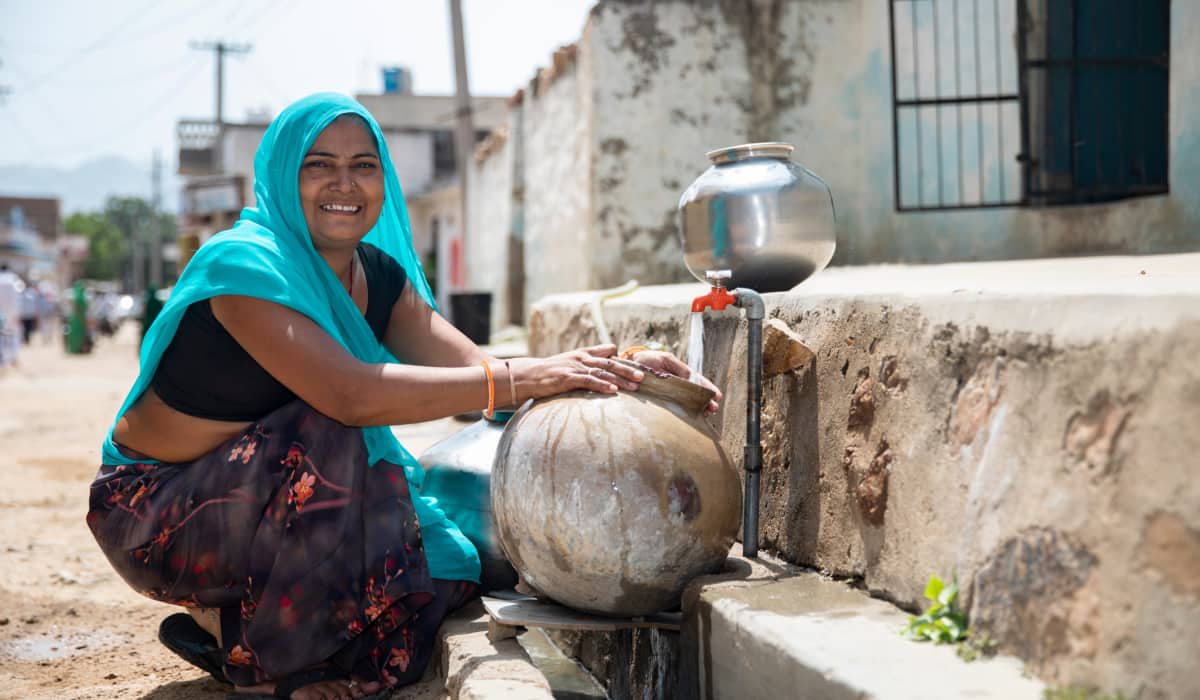
For generations, the sight of women carrying pots of water on their heads was an everyday scene in rural India. It was more than a chore, it was a necessity that was an integral part of their everyday life. The water was brought back, often just one or two pots which had to be stretched for drinking, cooking, cleaning, and washing. It was a routine that left little time for rest, education, or income-generating work, and the burden fell most heavily on women.

Before 2014 water scarcity, one of India’s most pressing problems, was met with little urgency or vision. Access to safe drinking water was fragmented, villages relied on distant sources, and nationwide household tap connections were seen as unrealistic.

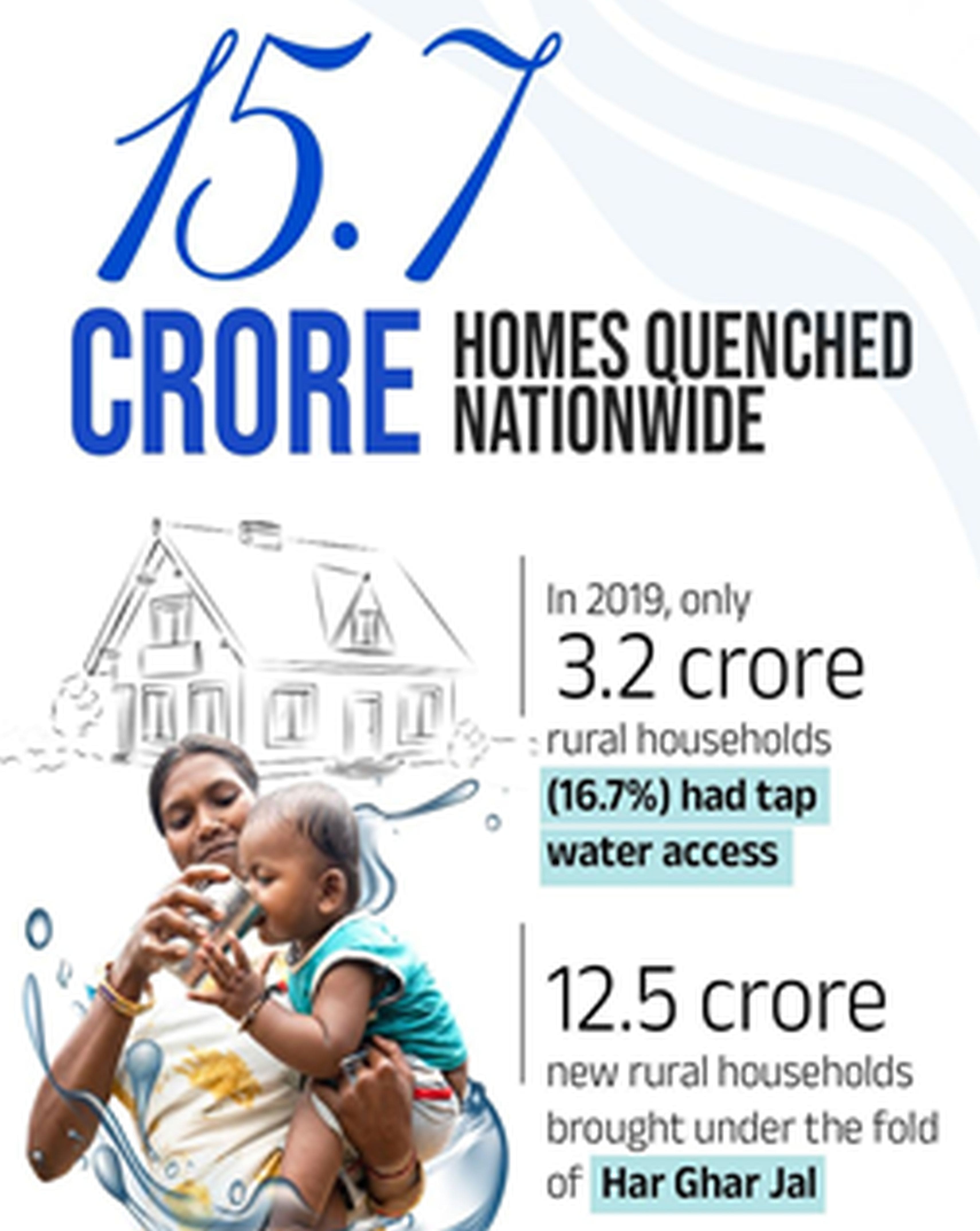
This reality began to shift in 2019, when the Government of India launched the Jal Jeevan Mission (JJM). A centrally sponsored initiative which aims at providing a Functional Household Tap Connection (FHTC) to every rural household. At that time, only 3.2 crore rural households, a modest 16.7% of the total, had tap water. The rest still depended on community sources, often far from home.

As of July 2025, the progress under the Har Ghar Jal program has been exceptional, with 12.5 crore additional rural households connected, bringing the total to over 15.7 crore. The program has achieved 100% tap water coverage in 200 districts and over 2.6 lakh villages, with 8 states and 3 union territories now fully covered. For millions, this means not just access to water at home, but saved time, improved health, and restored dignity. Nearly 80% of tap water coverage has been achieved in 112 aspirational districts, a significant rise from less than 8%. Additionally, 59 lakh households in LWE districts have gained tap water connections, ensuring development reaches every corner. Acknowledging both the significant progress and the road ahead, the Union Budget 2025–26 announced the program’s extension until 2028 with an increased budget.

The Jal Jeevan Mission, launched nationally in 2019, traces its origins to Gujarat, where Narendra Modi, as Chief Minister, tackled water scarcity in the arid state through the Sujalam Sufalam initiative. This effort formed a blueprint for a mission that would one day aim to provide tap water to every rural household in India.

Though drinking water is a State subject, the Government of India has taken on the role of a committed partner, providing technical and financial support while empowering States to plan and implement local solutions. To keep the Mission on track, a strong monitoring system links Aadhaar for targeting, geo-tags assets, conducts third-party inspections, and uses IoT devices to track village water flow.

The Jal Jeevan Mission’s objectives are as much about people as they are about pipes. By prioritizing underserved and water-stressed areas, ensuring that schools, Anganwadi centres, and health facilities have running water, and encouraging local communities to take ownership through contributions or shramdaan, the Mission aims to make safe water everyone’s responsibility..

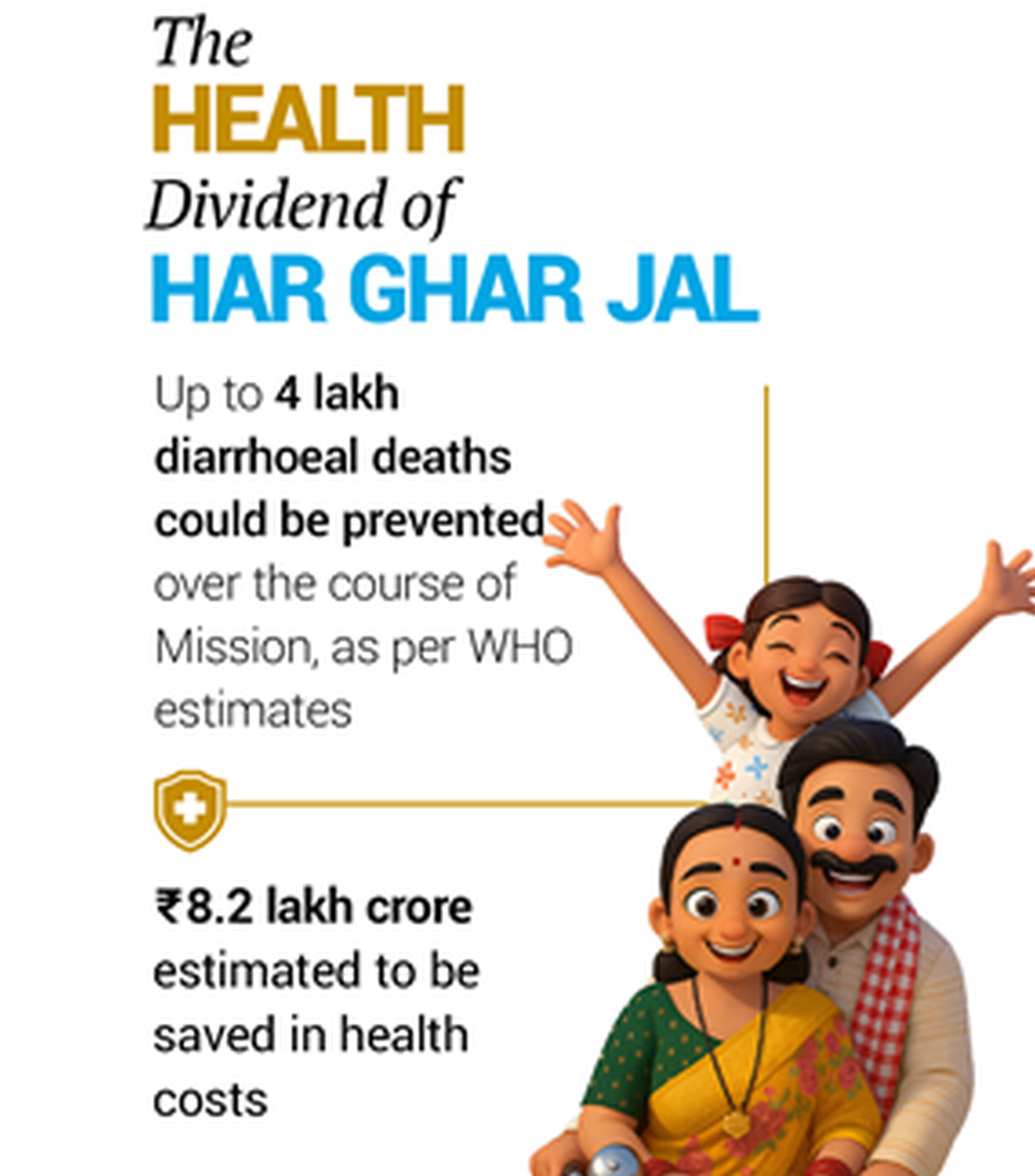
The impact reaches far beyond convenience. The World Health Organization estimates that achieving JJM’s targets could save over 5.5 crore hours each day, time that can now be spent on education, work, or family. 9 crore women no longer need to fetch water from outside. WHO also projects that safe water for all could prevent nearly 4 lakh deaths from diarrhoeal disease and save Rs. 8.2 lakh crores in health costs. Additionally, according to IIM Bangalore and the International Labour Organization, JJM has generated nearly 3 crore person-years of employment during its build-out, with nearly 25 lakh women are trained to use Field testing Kits.

From the quiet relief of a mother filling a glass of clean water in her kitchen, to the confidence of a school where children can drink without worry, the Jal Jeevan Mission is changing what it means to live in rural India.