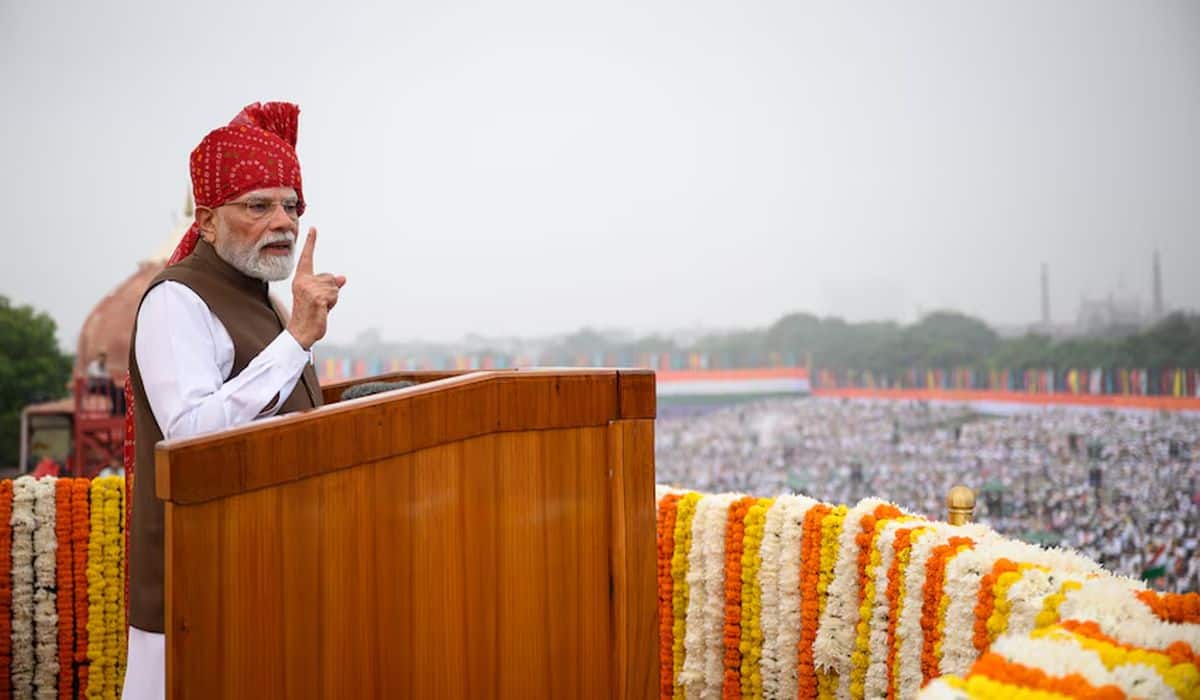
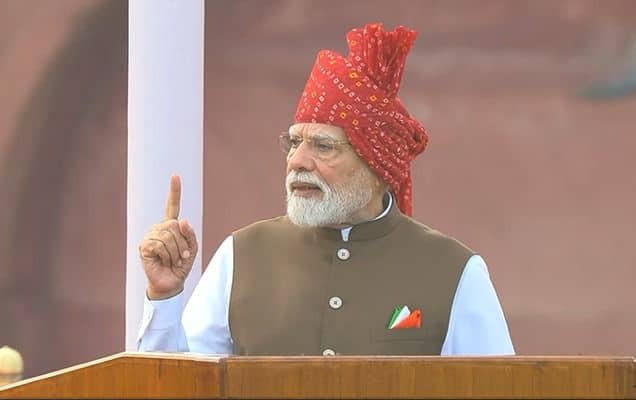
Chief Minister Shri Narendra Modi addressed NRIs across 12 cities in USA through video conferencing.
In a comprehensive speech, Shri Modi speaks on various facets of Gujarat’s development.
Your passports can change but not the colour of your blood. Laud your concern for Gujarat and its growth: Shri Modi
All three sectors (agriculture, industry and services) growing side by side in Gujarat: Shri Modi
Gujarati has become a global community, Gujarat a global destination: Shri Modi
Gujarat has shown the way on how India’s gloomy condition can be altered: Shri Modi
Lakhs of people all over the world viewed the live telecast.
On the morning of Sunday 20th May 2012, Gujarat Chief Minister Shri Narendra Modi addressed Non Resident Gujaratis (NRGs) and Non Resident Indians (NRIs) across 12 cities of USA through video conferencing. The Chief Minister spoke on the various development initiatives of Gujarat in the last decade.
Beginning his speech, Shri Modi said that even though it is 7 AM in Gujarat, there are many people watching this programme, which is indeed wonderful. He congratulated the diaspora for always remembering their Motherland and for taking this initiative to celebrate Gujarat’s foundation day.
Shri Modi pointed out that not only Gujaratis but also people from all over India have gone overseas and praised the development in Gujarat. He stated that his Mantra is the development of Gujarat for the development of India and added that whatever Gujarat is today, the credit for it must go to 6 crore people of Gujarat who have dreamt and worked hard to realize these dreams.
Reminding people about Gujarat’s glorious history, Shri Modi asked who could forget Mahatma Gandhi and Sardar Patel? He affirmed that Gujarat had contributed in both strands of the freedom struggle. If Mahatma Gandhi and Sardar Patel led the non- violent struggle, Gujarat is also home to Shyamji Krishnavarma who inspired revolutionary nationalists. He also believed that Gujaratis are a global community who imbibe cultures from all over the world, mixing well wherever he or she goes. The fact that so many people worked hard to make this programme a success and even wrote letters with ideas for Gujarat shows how much love there still is for Gujarat, the Chief Minister pointed out, adding that he is determined not to let tis love go away just like that.

Shri Modi spoke in depth about the decade of peace and development in Gujarat. He brought out that in 2001 Gujarat was facing a revenue deficit of Rs 6700 crore but in ten years it has become a surplus state, that too without imposing additional taxes on the people. All Gujarat did was to give existing tax structures more efficiency. In 2001, Gujarat had just faced an Earthquake and before that a drought and cyclone and everybody had written off Gujarat but due to the efforts of the people, Gujarat overcame each and every challenge to develop stronger.
The Chief Minister shared that Gujarat has achieved balanced growth in all three sectors- Agriculture, Industry and Services. Talking about agriculture, Shri Modi said that at a time when India’s agriculture is not growing beyond 3%, Gujarat’s agriculture is growing at 11%. This despite the fact that the unlike the rest of the country, Gujarat is not blessed with perennial rivers except and is home to a vast Rann. While agriculture income was Rs. 14,700 crore a decade ago, it is now Rs. 98,000 crore and the money is going in the pockets of the farmers.
Shri Modi reiterated his commitment that he will not let agriculture land get diminished. Rejecting the canards spread by anti- Gujarat elements, Shri Modi asserted that from 108 lakh hectares of agriculture land in 2001, Gujarat now has 145 lakh hectares of agriculture land. This is the first time that agriculture and industry are thriving side by side at such a vast scale! The Chief Minister shared that farmers from Vanbandhu areas of Dang, Valsad are cultivating cashew nuts, thus suggesting the scale of agriculture development in Gujarat.
Shri Modi told the audience that Gujarat’s milk production rose by 68% and Gujarat is making great strides in cotton production. In 2001 Gujarat produced 23 lakh bales of cotton but today the figure stands at 1 crore 23 lakh bales of cotton. Potatoes from Gujarat are now being exported and farmers in Gujarat are now using the latest technology to harness greater growth.
The Chief Minister recalled the time when industrial development in Gujarat meant only the Valsad- Vapi- Ankleshwar belt but even that had changed. Industrial development has travelled all across Gujarat. While earlier the pharmaceutical and chemical industries were thriving, today all types of industries are gaining a foothold across Gujarat. Shri Modi shared with immense delight that Gujarat is surging ahead in the manufacturing sector and that the state is all set to be Asia’s auto- hub with all cars across the world having at least one part or another made in Gujarat.Even American auto giant Ford is coming to Gujarat. He invited the audience to visit Gujarat during the upcoming 2013 Vibrant Gujarat summit and the Uttarayan festivities. Shri Modi pointed out that American companies have invested Rs. 15,000 crore in Gujarat and Canada has been working with Gujarat for quite some time now.
In his speech, Shri Modi shared Gujarat’s concern for the environment. Gujarat is among the 4 Governments in the world that have a dedicated department for climate change and today the water table in Gujarat gas risen from 3m to 13m! On the infrastructure front, all villages of Gujarat have 24/7 electricity and 18,000 villages enjoy broadband connectivity. The Government brought CNG to Ahmedabad, which from being among the most polluted cities is now being ranked as the ‘Best City to Live’ by leading newspapers.
Shri Modi recounted that earlier Gujaratis made the best tourist. In the by-lanes of any city in the world one could hear a ‘Kem Cho’ and in any 5- Star Hotel a box of Khakhras would open but today Gujarat is a vibrant tourist destination in its own right. How can the land of Gandhi, the coasts and Lion of Gir not be a tourist destination, he asked? At a time when tourism in India is growing at 10%, Gujarat’s tourism is growing at 16%. This also shows how Gujarat is focusing on the services sector, Shri Modi added.
The Chief Minister emphatically stated that all this development is taking place with an aim to improve the life of the poor. He said that in contrast to the earlier times when calling an ambulance was like waiting till eternity, Gujarat is now well known for its 108 service. The Government put focus on maternal health through initiatives such as the Chiranjeevi Yojana and today, 98% of deliveries are held in hospitals thus saving so many mothers and babies in Gujarat.
Talking about the common complaint of cleanliness, Shri Modi spoke about Gujarat’s landmark initiatives to build toilets for the people. At one time 46-lakh out of the 56-lakh households did not have toilets while now 44 lakh toilets have been built and the rest would be completed very soon. In the past, Gujarat had only 4 Nirmal Villages while today there are 4434 Nirmal Villages. As far as public amenities are concerned, 9000 villages and 121 cities are given clean drinking water through Narmada Canal and 2200 km pipeline, declared Shri Modi.
On the issue of providing education, Shri Modi said that the Gujarat Government has given a renewed impetus to education because of one is blessed by Goddess Saraswati, how can Lakshmi stay far behind? Drop out rates in Gujarat are now at 2% and there is a cent percent enrolment rate in the state. Shri Modi shared how in the month of June during the peak of summer the entire state Government goes into the villages of Gujarat, asking parents to educate the girl child, to send her to school. There was time when there were only 500 medical seats in 2001 but today the number has shot up to 6000. From a shortage of 8000 engineering seats, the number has gone upto 42,000. This has helped particularly the poor, who earlier got trapped in the cycle of donations.
Shri Modi asserted that not a single sphere is left out from Gujarat’s development journey. He spoke about Gujarat’s advances in solar energy and how it dedicated 600 MW to the nation while the rest of the country is producing only 120 MW of solar energy. The Solar Park at Charanka will be the Asia’s largest. He listed the innovative canal-top solar power project that is extremely beneficial because per year it would save a crore litres of water per kilometer from evaporation and would save 16% electricity and land for farmers. Shri Modi said Gujarat has 1600 km coastline where the Government will develop ‘New Gujarat within Gujarat’. Projects such as DMIC will change the face of Gujarat too, he said.
The Chief Minister talked about how value addition has become the way ahead. He asked, why can’t a farmer producing mango look at preparing pickles or a farmer producing tomatoes think about ketchup? He brought out some of Gujarat’s initiatives for various sections of society, be it senior citizens, Rs. 200 crore for treating the poor when sick or the Rs. 40,000 crore Vanbandhu Kalyan Yojana for the Vanbandhu people of Gujarat. He further spoke on Gujarat’s focus on skill development. Being the 150th birth anniversary celebrations of Swami Vivekananda, Gujarat is celebrating 2012 as ‘Yuva Shakti Varsh’ with a great focus on youth and skill development. Shri Modi said in a span of a week, a record 65,000 jobs were given to youngsters.
While concluding his speech, Shri Modi said that Gujarat is a land of Shanti, Sadbhavana and Vikas. He expressed joy in the fact that people from all states are working in Gujarat and living very happily. He stated that it is our responsibility to make the dreams of our forefathers into a reality. He again thanked the organizers and ended his speech with ‘Jay Jay Garvi Gujarat!’