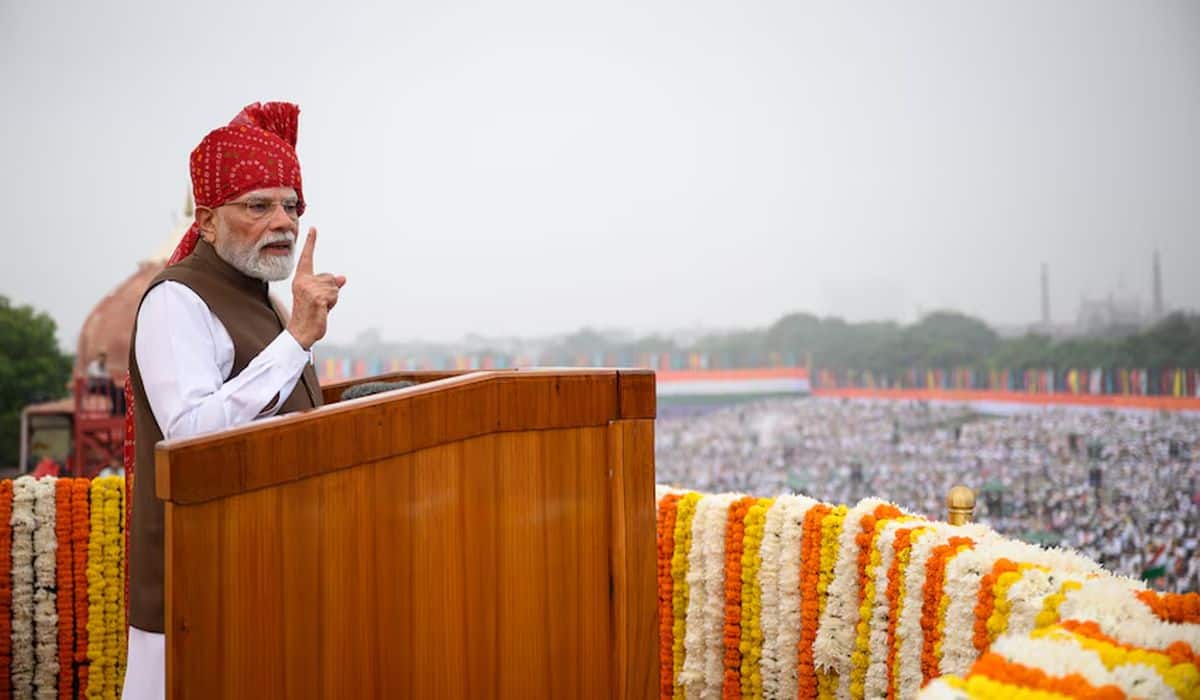
On the morning of Thursday 9th January 2014 Shri Narendra Modi addressed the Indian diaspora at the Pravasi Bharatiya Divas 2014 in New Delhi. Shri Modi talked at length about the rich contribution of the Indian diaspora in the development of India and assured them that India will never let them down. He called for inclusive, interactive, decentralized governance.
Here is the text of Shri Modi’s speech --
My dear Sisters and Brothers,
It gives me great pleasure to address this august gathering of my fellow Indians from across the world yet again at Pravasi Bharatiya Divas.
As India stands at an important juncture of history, I am reminded and inspired by its glorious past.
The very cradle of the human race; for centuries India was the World’s guiding beacon -
Vishwa Guru Bharat. Also called
Sone ki Chidiya (Golden Bird); it was famous as the land of fabulous wealth, knowledge, spirituality, culture and diversity. Stemming from a deeper space of mind and spirit rather than mere resources and tools; all this elicited spontaneous love, respect and awe world over. As aptly surmised by historian Will Durant, Mother India in many ways was the Mother of All!
From Swaraj to Surajya

Amongst the many other firsts, India was also the birthplace of self governance and democracy, through its village communities. In fact,
Surajya (good governance) and
Sushashan (good administration) were concepts extensively explored and developed in Indian traditions of leadership.
With the British however, came years of a governing class having the sole motive of exploiting the country’s resources for the benefit of the crown. This changed the very nature of the Government of the day, overriding centuries of best practices, principles and performance. Independence gave India a chance at redemption, with the nation getting an opportunity of reversing the practice of government to one of ‘giving to every citizen unto the last’. Unfortunately however, independent India’s government has not been able to live up to these expectations. Even after decades of Independence, the country has not been able to make the important transition from
Swarajya (freedom) to
Surajya (good governance).
The last decade in particular has witnessed unprecedented depths of petty politics, self interest and exploitation overwhelming the exalted principles of inclusive and sustainable nation building. A deteriorating economy; unrelenting stream of scandals and corruption exposés; poor delivery of basic services; policy paralysis, stagnating society and an overall atmosphere of divisive politics - has severely hit the people’s perception of, and trust in, the government and its leaders.
Morality has been thrown out of governance, with Trust being the biggest victim. A government of Acts rather than Action; has paralyzed India’s polity into one of promises over performance. Institutions have been destroyed. A misleading sense of entitlement has further highlighted the missing delivery mechanism.
Today, if there is one thing holding back our nation brimming with potential and energy; it is the lack of
Surajya. This must change.
India’s leadership at all levels must rise to the challenge elevating their thoughts and actions to a higher plane of ideals and principles.
Surajya (Good Governance) and
Sushashan (Good Administration) need to be firmly placed on the agenda! And this must not remain merely an academic discussion. We must translate these principles and goals into action and results on the ground, taking the people along.
The role of the State must be evolved from merely carrying out regular day to day business of
government; to strategically guiding the nation towards a brighter future through
governance. Growth and Wealth creation must be nurtured, but not be seen as an ends in themselves. They must be taken to be but means to a much larger end – one of bringing about happiness on the faces of each and every one of its citizens. The fruits of growth and development must reach the weakest, most deprived and remotest of people, without which any growth is neither sound economically nor socially. Moreover, sustainability must be placed at the centre of the State’s thoughts and actions, working on the principle that inclusive growth cannot be limited by the barriers of time and space - it has to be built on the foundations of the past, leverage on the opportunities of the present, and preserve and enhance its resources for the future.
India @ 75 – Amrut Mahotsav
As India celebrates its Amrut Mahotsav in 2022, completing 75 years of Independence, what can be a greater tribute than a developed India which is globally competitive and admired; as well as locally inspiring, inclusive, resilient and united. We must aspire towards actualizing:
- Basic Amenities to All – from village to city, rich to poor
- Quality life in Villages & Cities – driven by speed, scale, skill & smartness
- Flourishing Agriculture - enabling rural prosperity
- Productively working Youth – as the drivers of change
- Equally involved Women – evolving from home maker to Nation builder
- Robust physical & social Infrastructure – which is globally benchmarked
- Globally Competitive Industry & Trade – establishing Brand India
- International Standards in Goods & Services – better than the best in the world
- Innovation & Technology driven Society & Economy – driving the change
- Vibrant Democracy - participative and decentralized
- Deepening Institutions – delivering Pro-active Pro-people Good Governance
Believe me such an India is possible. All we need to do is join our hearts and hands in the spirit of
Ek Bharat –
Shrestha Bharat
(United India - Grand India); always putting the national interest first - India First
. The best foundation is our own culture, the best tools our own hands and the best material our own aspiration.
In this sacred mission of developement, our two biggest strengths lie in our Democracy and Demography. India’s youth give it the power of new energy, while India’s democracy gives it the warmth of participation and inclusion. How we leverage on these two will define the future of not just India, but the World at large.
Democracy - 1st Pillar

I firmly believe that democracy is a necessity if India is to progress. What is required is Deepening of our Democracy, enhancing the levels of Participation, Information and Institutionalization.
We must understand that problems arise only when a disconnect occurs. When both the People as well as Government forget each other once the elections are over. Both sides wrongly believe that a periodic contract has been given. And that only towards the end an account is to be taken. Another problem is that we take the Government as provider and people as beneficiaries. This prevents people from being active partners in the development process. It also creates a mismatch between what is needed and what is delivered.
This is where we need to work. We need to transition from a Representative to a Participative Democracy. A democracy in its truest sense is an organic system. Every moment and every activity is an inter-play between the people and the Government. We must understand that people power when combined with good governance, brings about real, deep and lasting change. This combination can achieve almost everything from eliminating corruption to ending malnutrition and illiteracy.
The essence of Good Governance thus is to empower people and place them at the centre of the development process. Through such an approach Government becomes open and accountable to the people’s needs and the effective delivery of public services accelerates the improvement in quality of life.
In Gujarat we call this style of governance ‘
development as a mass movement’; where our people are integral parts of our varied initiatives. This is especially so in social sectors like education, health and agriculture. We undertake annual drives in which on one hand, we engage the entire political leadership and administrative machinery. And on the other, we involve people from all walks of life. Similarly in drinking water, we have given the local management to village level committees of people. This initiative under the banner of our WASMO institution has received the UN Public Service Award.
Only by harnessing the people’s power has Gujarat become famous for solving the State’s persistent problems and rising to a leading position in economic growth, social welfare, agricultural productivity and environmentally sustainable practices. This mode of partnering with citizens in an open manner has made the Government accountable to the people’s needs. SWAGAT (State Wide Attention on Grievances by Application of Technology) has brought governance issues of the people directly to our attention and has meant swift solutions are given ensuring near-100% citizen satisfaction. The citation of the UN Public Service Award received for this captures it all, recognizing the Gujarat government for bring about Transparency, Accountability and Responsiveness.
I can give you numerous other such examples, where our innovations have won national and international awards. Based on this Gujarat experience, I can say with great conviction that this can be done. All that is required is honesty of purpose and integrity in intentions. Governments have to understand that they are merely Guardians of the people’s interests. They are only Trustees of the nation’s resources. They must also have the humility to accept that the collective wisdom of the people knows better.
Demography - 2nd Pillar
As the youngest country in the world; I firmly believe that our Youth are our most invaluable resource. The future of not just India, but the world at large lies in this pool of energy. Blessed with such a prized resource, we must invest in the same to unleash its potential. We need to nurture and empower our youth with education, skills, opportunities and an overall enabling environment.
India is brimming with the tremendous energy of the youth. Whatever be the future we desire, we must keep our youth at the centre. We need to bring about not just Youth Development, but evolve a model of Youth-led development. If we do this, we can surge ahead at an unmatchable pace!
A society that does not give importance to education cannot progress. The strength of democracy is in mass education. This is all the more so since the 21st century is the century of knowledge. Therefore, education must be central to the vision of a future India.
In Gujarat, we have made focused efforts from primary to higher education and skill development; not only increasing the reach and infrastructure, but also enhancing quality.
Our examples of initiatives in education stretch from
Shaala Praveshotsav (school enrolment drive), with a special thrust on the girl child through
Kanya Kelavani;
to emphasizing on the quality of education in government schools through
Gunotsav (annual quality drive). From expanding science education in schools to ramping up technical, management and medical seats in colleges. From setting up over 30 new universities, in highly specialised domains like Forensics, Security, Petroleum, Law and Sports; to reforming and modernizing the curriculum.
In skill development, Gujarat’s approach has been flexible, broad based and long-term. We have not just expanded our
ITIs manifold; we have also upgraded them through modernized curriculum, infrastructure and strong industry interface. More than 50% of our ITIs have been adopted by companies and run on PPP mode. We have also given ITI education academic equivalence opening up windows of opportunity.
Soft
skill training has been given importance through programs like
SCOPE for English education and
eMpower for computer literacy. Our
Kaushalya Vardhan Kendras which provide short term practical courses at the people’s doorstep has been recognized with the PM Award for excellence last year.
Our commitment has been to turn every young mind of Gujarat into a powerhouse of innovation and dedication. If Gujarat can, why can India not!
Vishwa Guru Bharat
Walking this path will lead us to a strong and self reliant India. It will also mean a self-confident 21st century Global India, regaining its rightful place at the grand table of great nations. This re-actualization of
Vishwa Guru Bharat in today’s times of global instability and insecurity, has the potential of providing the much needed alchemy of healing, bonding and energizing to the World at large.
India has always played a major role in world affairs, offering a lot to the World. This has been its tradition since time immemorial. The magnetic power of India has always been in its ancient wisdom and heritage, elucidating principles like harmony and equity. This continues to be equally, if not more relevant to the world today. As modern day inheritors and ambassadors of this great wisdom; all of us - especially those living across the world - must live up to the same, making the world a better place.
Let me give you a few important examples. At the
Humanity level, Truth has consistently remained the biggest brand through the ages. India pioneered and maintained the same, guided by the principle of ‘
Satyameva Jayate’ – that ultimately Truth Alone Prevails. Our scriptures advocated this. So did our leading figures; from Buddha in the ancient world to Mahatma Gandhi in the modern. Where there is truth, there is openness, acceptability and fairness. This leads to peace and harmony. This continues to be India’s most relevant teaching to humanity.

At the
Community level, India is built on the deep-rooted social institution of Family. However, we do not stop at our own family. Our family extends to the whole world, believing everyone to be part of the same cosmic Family - ‘
Vasudhaiva Kutumbkam’. Thus, compassion and co-existence is built in our very ethos. Today’s international relations needs this. Beyond mere competitors or opponents, countries must see each other as integral parts of the Global village. Automatically, many of our problems will be solved.
At the
Economic level, Indian philosophy has delved deep in to the idea of Wealth. Wealth creation is not considered bad, as long as it is done through right means. Furthermore, this wealth is constrained by three ultimate eventualities. In addition to using it for one’s happiness, it should be used for helping others; as the only other remaining possibility is decay and destruction. This insight holds lessons for all levels - individual, corporation and nation.
At the
Environment level, Indian belief has been best encapsulated in Gandhi ji’s words that “there is enough for everyone’s need - but not for everyone’s greed”. Need is not the issue. Greed is. Environmental problems are arising because we have become greedy. We are greedy in that we only care about today, unconcerned about the coming generations. We are greedy in that we think only of the human species, not caring about the countless other species who co-exist with us. This greed is reflected at the individual level, as well as at the levels of Businesses and Government. Indian philosophy on the contrary is that you can enjoy life only when the surroundings are healthy and harmonious. That is why in our mythology trees are worshipped. Animals are worshipped. Even water, earth and sky are worshipped. We have been taught to replenish what we take from the Nature. India’s ancient message of Sustainability thus can show the way in the fight against Global Warming and Climate Change.
Diaspora to play a crucial role
India’s roughly 2.5 crore strong diaspora is spread in over 100 countries across the world. You have assimilated wherever you have settled. You have engaged constructively with the local communities, taking up responsibilities to play major roles in society. This is a matter of great pride. You thus take India and all that it stands for, to the World.
Moreover, in spite of being thousands of miles away, you also continue playing a crucial role in nation building back home. Gandhi ji had returned to India in 1915. I appeal to each of you to mark the 100th year of this momentous occasion, by making 2015 a year when you too give back and contribute to the Mother India. Whatever we are today is after all because of what our nation and people have done for us. It is now time to give back to it. There can be no greater tribute to the Father of the Nation.
India faces a water shed election in a few months. At this crucial juncture in our nation’s history, you too should not stay back. You must be a part of the revolution taking place. Try and come back to vote at the time of elections. If that is not possible, actively engage with the political process from wherever you are; debating and brainstorming on the right path ahead with friends and family back home, as well as the nation at large. This will add to India’s strengths – its development, governance and unity.
We in fact envisioned the Statue of Unity to reinforce and seek inspiration from these very ideals of Sardar Vallabh bhai Patel. As the world’s tallest statue at a height of 182 meters, this is going to be a towering tribute to the Iron Man of India, inspiring generations to come. The building of this iconic statue is going to be equally unique, with Indians from across the nation and world coming together in one inspiring movement - one of independent India’s largest social mobilizations.
To be built by the united ‘iron will’ of the people; iron tools used by our farmers to toil our land, are going to be collected under the
Loha Movement from across the country to go into the construction of the statue complex.
Write for Unity is another such drive being conducted in schools across the country, introducing our children to Sardar Patel and what he stood for. The
Run for Unity organized on 15 December 2013 was one more such example. Almost five million people across 1,100 locations around the country ran together in one heartfelt rhythm of unity. Further installments are now being planned in various places across the globe, and I urge you all to actively participate.
History beckons …
Friends, India stands at an inflexion point today, poised to play a fundamental role in defining the future of the world – economically, socially, culturally, spiritually as well as politically. To quote Sri Aurobindo, “India is destined once more to re-mould the life of the world and restore the peace of the human spirit”.
I firmly believe that our time has come! It is pertinent that we reach back into our rich traditions, seeking inspiration and learnings. And revisit our foundations of knowledge, leadership and governance to seek to build a modern epitome of
Surajya and
Sushashan; blending tradition with modernity to create a unique ethos. Our fellow Citizens deserve nothing less – our glorious Nation deserves nothing less – the entire World itself deserves nothing less!