Dahej SEZ Ltd signs MoU with a Japanese-Singaporean consortium to set up Asia’s most modern desalination plant at Dahej on DMIC

Chief Minster Narendra Modi describes the MoU as Gujarat Government’s landmark initiative on World Water Day

Gandhinagar, Thursday: A memorandum of understanding (MoU) was signed between Gujarat Government’s joint sector enterprise Dahej SEZ Ltd and a consortium of Japanese-Singapore companies here today to build Asia’s biggest desalination plant near Dahej in south Gujarat, situated on the Delhi-Mumbai Industrial Corridor (DMIC).

The consortium, comprising Hitachi and ITOCHO of Japan and Hyflux of Singapore, will work as co-developers with Dahej Spring Desalination Private Limited set up to implement the project.

The MoU was signed in the presence of Japan’s Ambassador Mr. Akitaka Saiki, Gujarat Chief Minister Mr. Narendra Modi, Minister of State for Energy Mr. Saurabh Patel and Chief Secretary Mr. A.K. Joti.

Also present on the occasion were DMIC Development Company Chief Executive Officer Mr. Amitabh Kant and Government of Japan’s METI Deputy Director-General Mr. Goto, besides senior officers of the companies concerned.

Speaking on the occasion, Mr. Modi described the agreement as Gujarat Government’s landmark initiative for water management on World Water Day. He said the project would prove to be a boon for a water-deficit state like Gujarat in recycling sea water and in water conservation measures. The project would also be unique in the sense as it would be run on solar energy. He said the Gujarat Government would not like to use the water meant for drinking and irrigation for industries.

The Chief Minister said the Dahej SEZ is India’s largest Special Economic Zone and is recognized to be the world’s best free trade zone among the top 25. He thanked the Japanese Government and other companies for extending their cooperation in setting up a modern desalination plant in Gujarat.

Japan’s Ambassador Mr. Saiki and METI Deputy Director-General Mr. Goto were also in high praise of Gujarat Government’s dynamic leadership and progressive policies and described their cooperation with Gujarat Government in the implementation of development projects as effective.

Explore More
Today, the entire country and entire world is filled with the spirit of Bhagwan Shri Ram: PM Modi at Dhwajarohan Utsav in Ayodhya

Popular Speeches

Today, the entire country and entire world is filled with the spirit of Bhagwan Shri Ram: PM Modi at Dhwajarohan Utsav in Ayodhya
PMAY-U Nears 1.25 Crore Homes: Top 10 States With The Highest PMAY-U Completion Rates

Media Coverage

PMAY-U Nears 1.25 Crore Homes: Top 10 States With The Highest PMAY-U Completion Rates
NM on the go

Nm on the go

Always be the first to hear from the PM. Get the App Now!
...
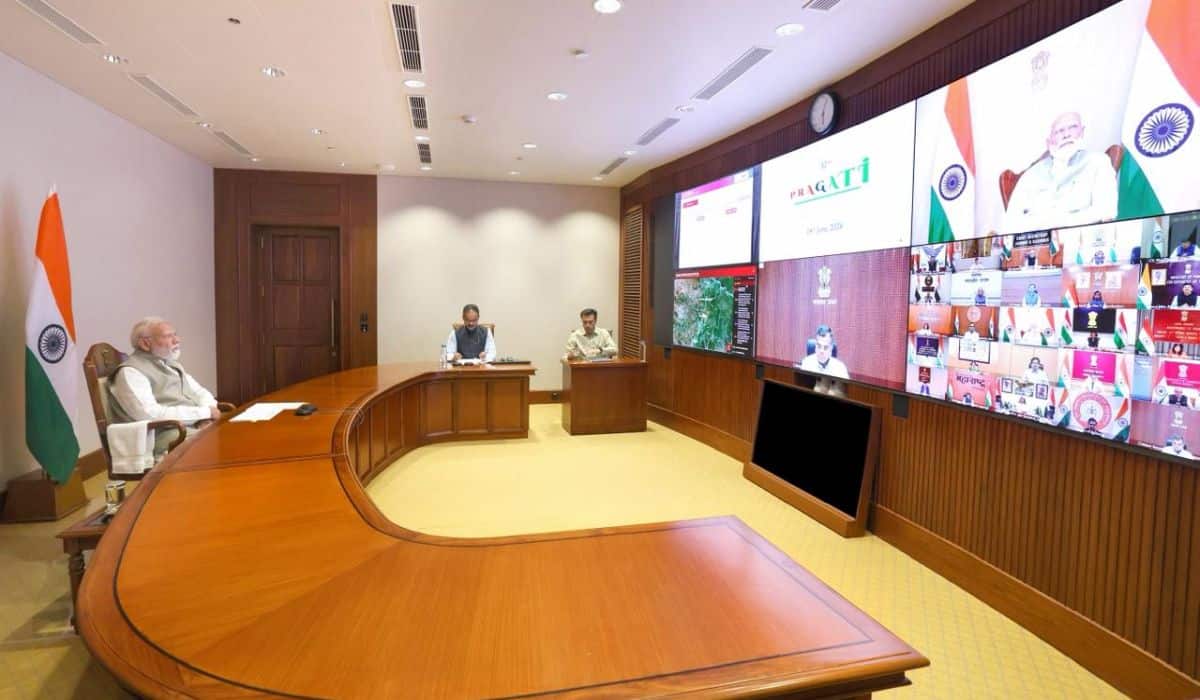
PM chairs 52nd PRAGATI Meeting
June 24, 2026
PM reviews four key infrastructure projects worth around ₹30,000 crore spanning four states across Road, Power, Industrial Corridor and Metro Rail sectors
PM emphasises use of PM GatiShakti National Master Plan and timely updation of project, utility and infrastructure data on the portal for efficient planning
PM asks Ministries and State Governments to resolve pending issues in a mission-mode manner and ensure close monitoring
PM reviews TB Mukt Bharat Abhiyan and emphasizes need to leverage latest digital technologies including AI
PM reviews grievances related to Cyber Crime and Digital Arrest and stresses timely action, coordinated response and e-Zero FIR registration mechanism

Prime Minister Shri Narendra Modi chaired the 52nd meeting of PRAGATI, the ICT-enabled, multi-modal platform aimed at fostering Pro-Active Governance and Timely Implementation, by seamlessly integrating efforts of the Central and State Governments, earlier today at Seva Teerth.

During the meeting, the Prime Minister reviewed four critical infrastructure projects across the Road, Power, Industrial Corridor and Metro Rail sectors, covering four States and costing around ₹30,000 crore. These projects, important for economic growth, regional connectivity, industrial development and public welfare, were reviewed with focus on timelines, inter-agency coordination, issue resolution and timely completion.

Prime Minister underlined that delays in infrastructure projects not only lead to cost escalation, but also deprive people and industries of timely benefits. He asked the concerned Ministries and State Governments to resolve pending issues in a mission-mode manner and ensure close monitoring at the highest level.

Prime Minister emphasised the use of PM GatiShakti National Master Plan for efficient planning and timely implementation of infrastructure projects. He also underlined the need for regular and timely updation of project details, utilities, infrastructure layers, clearances and other field-level information on the portal. He further emphasised that the platform must reflect the latest ground situation so that bottlenecks can be identified in advance, inter-agency coordination can be improved and decisions can be taken on the basis of reliable, real-time data.

Prime Minister reviewed TB Mukt Bharat Abhiyan and emphasised the need to leverage latest digital technologies including Artificial Intelligence. He suggested a team of NCC cadets and MY Bharat volunteers, for awareness, patient follow-up and community mobilisation.

Prime Minister also reviewed grievances related to Cyber Crime and Digital Arrest. He expressed concern over the rising misuse of digital platforms to defraud citizens and stressed that such matters require coordinated, sensitive and time-bound handling by all concerned agencies. He noted that citizens should not be made to run from one department or agency to another. He also emphasized the need for clear ownership, faster response, better coordination among law enforcement agencies, banks and digital platforms, and stronger public awareness campaigns.

Prime Minister observed that in cases involving cyber fraud, timely action is crucial to prevent financial loss and restore public confidence. He asked all stakeholders to work in close coordination to strengthen prevention, reporting, investigation and grievance redressal mechanisms. He also emphasised that States should work towards enabling e-Zero FIR mechanisms for faster registration and response in cyber fraud cases.