



ഇപ്പോൾ നിങ്ങൾക്ക് ദിവസത്തെ പ്രധാന വാർത്തകൾ ഒരിടത്ത് വായിക്കാൻ കഴിയും. സർക്കാരിനെയും പ്രധാനമന്ത്രിയെയും കുറിച്ചുള്ള ഏറ്റവും പുതിയ സംഭവവികാസങ്ങളെക്കുറിച്ചുള്ള വാർത്തകൾ വായിച്ച്, നിങ്ങളുടെ സുഹൃത്തുക്കളുമായും ബന്ധുക്കളുമായും പങ്കിടുക.!
Published By : Admin |
January 30, 2021 | 13:03 IST


Explore More

ജനപ്രിയ പ്രസംഗങ്ങൾ
ശ്രീരാമജന്മഭൂമി ക്ഷേത്രത്തിലെ പതാക ഉയർത്തൽ ഉത്സവത്തിനിടെ പ്രധാനമന്ത്രി നടത്തിയ പ്രസംഗം

Nm on the go
Always be the first to hear from the PM. Get the App Now!

India's FTAs and the Shift Towards Strategic Trade Policy After 2014
May 24, 2026
-
Share
-

-

-

International trade is no longer only an economic activity in the traditional sense; it has become a tool of strategic planning, risk management, and geopolitical positioning. But it was only after 2014, this approach has evolved into a more structured effort to diversify markets, strengthen economic partnerships, and align external trade agreements with domestic industrial and strategic priorities.The Modi Government trade policy has been shaped by considerations of supply chain security, partner reliability, and long-term national development goals.
Nations do not engage in trade only for economic gain, even though standard arguments in favour of free trade often present it that way. Lower costs, efficiency, and higher growth are important, but they do not capture the full picture. In practice, countries use trade to manage risk, build reliable partnerships, and avoid being placed in a position of dependence. The Modi government's choice of trade partners reflects an emphasis on diversification, predictability, and strategic alignment.
India has finalized 9 FTAs covering 38 developed countries since 2021 to boost exports, attract foreign investment, and integrate into global supply chains as part of its manufacturing push. These deals serve strategic, economic, and geopolitical goals, including reducing overdependence on specific markets and strengthening diplomatic ties. The Modi government's strategic policy shift since 2014 has recognized and expanded market access for Indian producers, as New Delhi deepened economic ties with countries and regions worldwide. Continued domestic reforms are driving global interest in the fastest-growing major economy.
The global environment has changed in the last decade. Trade is no longer insulated from geopolitics, and tariffs are deployed as tools of pressure, sometimes arbitrarily, and in an "unfair, unjustified and unreasonable" manner. For India, trade policy can not be separated from strategic resilience.
For a country like India, trade policy is now closely tied to its foreign policy choices. It is not treated as a separate economic track; instead, it is seen as a means to shape New Delhi's relationships, secure supply chains, and strengthen its position in an increasingly multipolar world.
India has moved away from treating FTAs solely as economic exercises. They are now designed and negotiated by the Modi government to sit between trade policy and strategic alignment. FTAs served as buffers and offered predictability at a time when unilateral action by some countries had become normalized.
From Conventional FTAs to Strategic Trade Partnerships
However, this was not always the case. India's earlier experience with FTAs was disappointing. Agreements signed from the late 1990s onward did not lead to meaningful export growth for India. Imports rose, leading to unsustainable trade deficits. For instance, following the 2010 implementation of the India-ASEAN Free Trade Agreement (AITIGA), India's export share actually fell after the agreement came into force.
Diversification became central to India's approach after 2014. India no longer felt comfortable leaning heavily on a narrow set of markets (traditionally, the Western markets). FTAs started serving to widen economic options rather than deepen dependence. They aligned with global supply chain shifts as firms sought to move parts of production away from China, especially after the pandemic.
New Delhi's emphasis on the Indo-Pacific, West Asia, and Africa is a conscious choice. These arrangements are developed to function as stabilizers and to lock in relationships expected to last beyond short-term trade cycles. Agreements such as the India-UAE CEPA (2022) and the India-Australia ECTA (2022) demonstrate India's strategic thinking.
Services have moved closer to the centre. Earlier FTAs did little for India's strengths in IT, healthcare, education, or digital services. Our agreements after 2014 have brought services, fintech, and investment flows more prominently into trade negotiations.
There is also a domestic angle that was missing earlier. The Modi government's policy remained focused on national development goals. FTAs have been tied to initiatives such as Make in India and the Production-Linked Incentive schemes. The aim has been gradual integration into global value chains and domestic employment generation well into the future.
These priorities have been reflected in India's decision to stay out of the Regional Comprehensive Economic Partnership. In 2019, Prime Minister Narendra Modi announced that India would not join RCEP, stating that the agreement did not adequately protect India's interests.
A bilateral route allowed India to control the pace of opening without compromising the structural stability of the Indian economy. Without joining RCEP, India secured many of its market access benefits through bilateral agreements. With the conclusion of FTA negotiations with New Zealand in 2025, India secured agreements with RCEP members and partners except China.
The decision to stay out of RCEP reflects that domestic producers are no longer an afterthought in the Modi Government's approach. And later agreements combined market access with safeguards for sensitive sectors and are linked to national development goals. For instance, in the India–UK trade deal (2025), India maintained protections for sensitive sectors, such as agriculture, while ensuring that Indian exporters benefit from tariff reductions. The reform-driven rise in the competitiveness of domestic goods and services, and the diversification of export products and markets through FTAs, are driving Indian exports. Despite geopolitical and tariff-related risks, India's exports are at an all-time high.
Diversification, Supply Chains, and India’s New Trade Geography
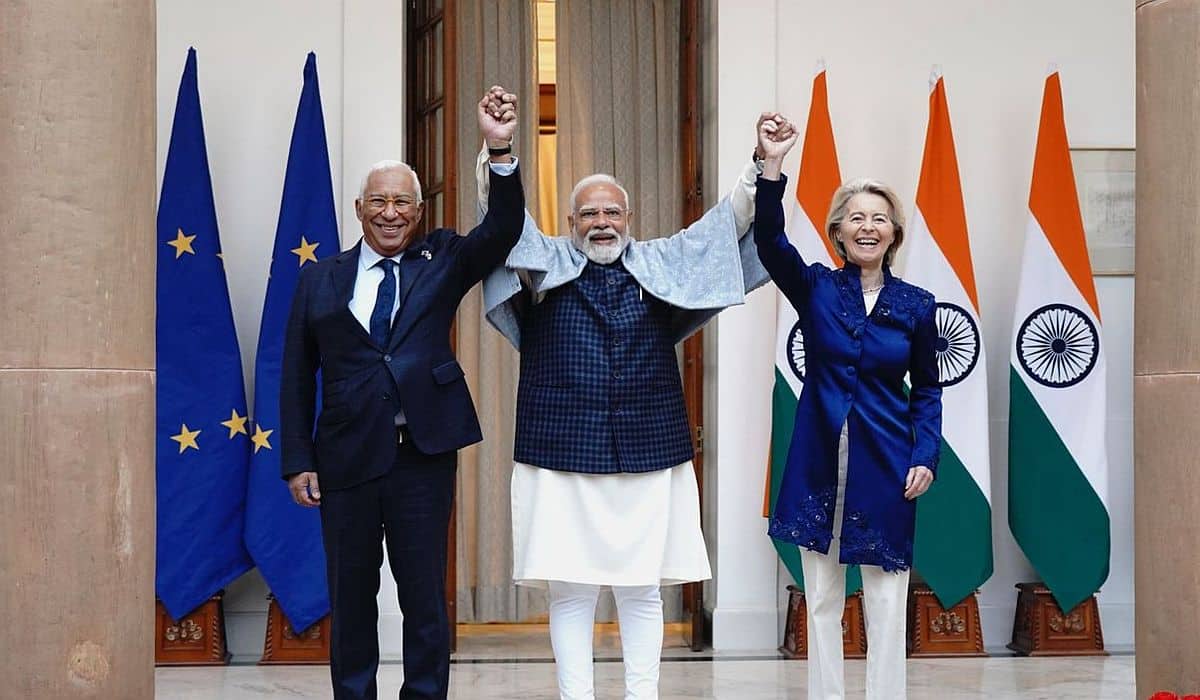
And as far as diversification is concerned, it reached a historic peak in January 2026 when, during the 16th India-EU Summit in New Delhi, Prime Minister Narendra Modi and EU leaders announced the successful conclusion of the India-EU Free Trade Agreements (FTA). Hailed as the "Mother of all deals" by European Commission President Ursula von der Leyen, the FTA covers 25% of global GDP, nearly one-third of world trade. The India-EU deal will significantly deepen India's integration with the European economy. And in a single shot, it gives Indian producers access to 27 markets of the EU. European companies operating in India will be able to expand their footprint and create local employment opportunities.
For India, these FTA's serves as a signal to the global business community and will complement other trade agreements. The same logic of expanding stable and diversified partnerships is now being applied beyond Europe. With several other countries and regional groupings still negotiating trade deals with India, Indian trade is likely to continue growing despite global risks.
India is set to begin negotiations for an FTA with the Gulf Cooperation Council. The bloc, comprising Saudi Arabia, the UAE, Qatar, Kuwait, Oman and Bahrain, signed the terms of reference in February 2026.
Prime Minister Narendra Modi has emphasized that the Gulf countries are India's "maritime neighbours." And this strategic messaging has allowed India's economic linkages with the GCC to increase steadily. In FY 2024–25, India-GCC bilateral trade crossed $178 billion and accounted for over 15% of India's global trade. There is significant momentum in the GCC to strengthen economic ties with India. India has already signed a CEPA with Oman (2025), which is also aimed at diversification. The agreement provides India's industrial exports access to wider regions, including the GCC, Eastern Europe, Central Asia, and African markets. The Modi government also previously signed a comprehensive trade agreement with the UAE (2022), which is already India's largest trade partner in the GCC.
Therefore, India's approach reflects an understanding that openness without balance can create dependence, and caution without engagement can limit growth. The effort has been to find a middle path where trade supports national strength rather than weakens it. By carefully choosing partners, sequencing its commitments, and linking external agreements to domestic priorities, India is trying to build a trade as a flexible strategic framework that allows New Delhi adaptability, and is aligned with India's development priorities.


Posted via www.narendramodi.in