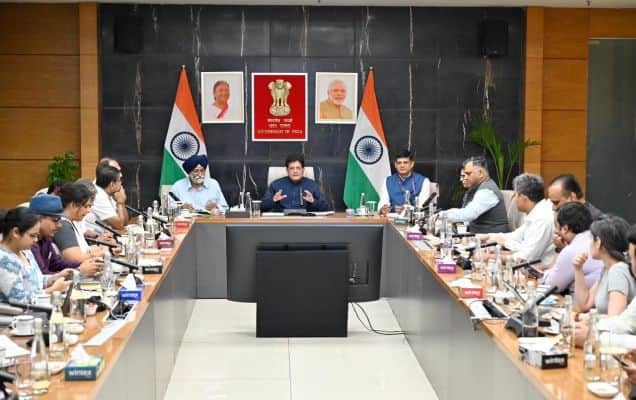
At the outset, I express my gratitude to all the honourable chief ministers for taking time out and presenting their points with great seriousness. But this is my request that all the states at the officer-level are involved in all the discussions that took place, we also have the experiences of the world, but still chief ministers have their special experience.
People working in public life have a special vision. Therefore, this is my request to you if your suggestions come in writing at the earliest, because all of you raised some important issues, it will be easier for us to work out our strategy. And this can’t be enforced on anybody. It can’t be that only the Indian government will take a decision (without consulting) the state governments. Together, we have to work on it and therefore everybody’s suggestions are very important.
A lot of information has emerged in the presentations related to corona infections. Earlier today, I talked to some of the chief ministers where the situation is slightly deteriorating. As far as the vaccine is concerned, there have been discussions regarding the status and distribution of vaccine. What the media says is quite different. Since we are part of the system, we will have to move ahead authentically. The situation has become somewhat clear.
There was a time when all of us were faced with the challenge of fighting an unknown force. But the collective efforts of the country took on the challenge and kept the losses at minimum.
As far as the recovery rate and fatality rate is concerned, the position of India is much better than most of the countries in the world. A huge network from testing to treatment is underway in the country with our concerted efforts. The network is constantly being expanded.
There has been special emphasis to ensure supply of oxygen and ventilators through PM CARES. Efforts are underway to make all the medical colleges and district hospitals in the country self-sufficient as far as oxygen generation is concerned. Therefore, the process to build over 160 oxygen plants has already started. Thousands of new ventilators have been ensured in hospitals across the country through the PM CARES Fund. Two thousand crore rupees have already been sanctioned for ventilators under the PM CARES Fund.
Friends,
The country has enough data in the wake of experience gained in the last 8-10 months since the outbreak of corona, there is comprehensive experience regarding management of corona. While formulating future strategy, I think we will also have to understand how the people and the society have reacted in the last few months. See, the behavior of the people of India during the corona has been contrasting in different stages and at different places.
There was tremendous fear in the first stage; nobody knew what will happen to him. And the situation was similar in the entire world. Everybody was in panic and was reacting accordingly. Initially, there were also incidents of suicides. A few of them committed suicide after they came to know that they have contracted corona.
Then gradually the second stage arrived. In the second stage, people became suspect towards others with fear still ruling. They felt that it was a serious matter if somebody had contracted corona and chose to maintain distance from him. In a way, there was an atmosphere of antipathy inside the house. And people began fearing ostracism from society because of the disease. This caused many people to hide their infection after the corona. They felt that they should not make it known to people; otherwise they will be cut off from the society. Gradually, people started realizing it and came out of it.
Then the third stage arrived, when people began to be quite careful. They started acknowledging it and announcing as well that they were down with corona, were going for isolation and quarantine and requested others to follow as well. In a way, people themselves began to convince others.
You must have noticed that people became more serious and alert. After the third stage, we are now in the fourth stage. When the recovery rate of corona has improved, people realize that this virus is not causing damage, it has become weakened. Many people have begun to think that they will recover in any case even if they fall ill.
Because of this, there has been negligence all around. And therefore, ahead of festivals, I had specially requested everybody with folded hands in my address to the nation not to become complacent because there is no vaccine, we don't have medicines. The only option left is how to save ourselves. We made mistakes and it became a threat due to little slackness.
In this fourth stage, we will have to re-sensitize people about the seriousness of corona. People are working on vaccines. We have to focus on corona only. We don’t have to let down the guard at any circumstance. Yes, initially, we had to impose some restrictions because we had to develop arrangements and had to educate people also. Now, we have a team which is prepared and people are also ready. If they practice restraint, things can improve. Whatever we prepare has to be implemented accordingly. And we will have to see that it does not spread further, there is no new problem.
We are moving to the shore after coming out of the deep sea of calamity. I don’t want it should happen to us as per the poetic composition --
हमारी किश्ती भी
वहां डूबी जहां पानी कम था।
Our boat too drowned where there was less water.
We don't have to let this situation return.
Friends,
Today, we are witnessing a surge of the infection in the countries where it was on the decline, as the chart shows. Similarly, this trend is worrisome in some of our states. Therefore, we all in the government and administration need to be more cautious and alert. We will need to step up efforts to reduce the transmission. We will have to give top priority to testing, confirmation, contact tracing and any deficiency associated with data will have to be rectified. Positivity rate has to be brought under the ambit of 5% and I believe that we will have to focus on smaller issues as to why it has increased by half or two times more. If we discuss at the local level instead of state level, perhaps we will be able to address the issue sooner.
Secondly, we all have felt that the proportion of RT PCR should increase. There should be better monitoring of isolated patients at home. You also know that if there is any laxity there, then the same patient is brought to the hospital in a very serious condition and we are not able to save him. We will have to better equip health centres at community and village levels. We will have to ensure that there is proper infrastructure and enough oxygen supply near villages.
Our target should be to bring the fatality rate below one percent. As I said, we need to find out why a death occurred in remote areas. We will be able to control the situation by focusing more on it. And one important thing, there should not be any reduction in awareness programmes. Society must be informed with the essential messages needed to prevent corona. Like some time ago, we engaged every organization, every influential person, they need to be reactivated.
Friends,
You are very aware about the news regarding corona vaccine both at the national and international levels. As you have been briefed through the presentation, the work on vaccine research is almost at the last stage both in the country as well as in the world. The Indian government is keeping a close eye on each and every development and we are in touch with everybody. It is not yet decided whether there will be one, two or three doses of vaccine or what will be its price.
Still, we don’t have answers to many questions, because, those who are going to develop it, there is huge competition in the corporate world. There are diplomatic interests of the countries as well. We also have to wait for guidelines from WHO, therefore, we have to move in the global context. We are also in touch with Indian developers and manufacturers. Besides, efforts are on and there is a system in place to have more interactions and real time communication with global regulators, governments of other countries, multilateral institutions and international companies.
Friends,
Right from the beginning, we have given highest priority to save the lives of the countrymen in the fight against corona. Now, once the vaccine comes, our priority will be that the corona vaccine reaches all, there can be no dispute on it. India's campaign on the corona vaccine is like a national commitment towards every citizen.
We will have to ensure that such a big vaccination drive is smooth, systematic and sustained, because it is going to be a long-drawn affair. Therefore, everybody, including every government and every organization, will have to work in tandem as a team.
Friends,
Not many great countries in the world have the kind of experience that India has regarding vaccine. Safety is equally important to us along with speed. Any vaccine that India will give to its citizens will meet every scientific criterion. As far as the distribution of vaccine is concerned, it is also being planned with all the states.
We have shared a blueprint with you regarding who will be the early beneficiaries of the vaccine, as suggested by WHO. But ultimately, we have to make a decision and the suggestion of all the states will be very important, because they know very well how it will be done in their states and how many extra cold chain storages will be required.
I think the states should prioritize it now and start building systems, like where it will be required and what will be the parameters. The departments have been notified but we will have to be prepared for its implementation. Additional supply will also be ensured, if necessary. We will very soon finalise a comprehensive plan with the state governments. The states and centre’s teams are constantly in touch with each other and work is in progress.
The central government had urged the States some time back to form a Steering Committee at the state level and the task force at the state and district level. I would like systems to be in place at the block level at the earliest and somebody will have to be tasked for it. These committees should have regular meetings, they should be trained and monitored, and the online training should also start. Along with our day-to-day business, we will also have to develop a system immediately while combating corona simultaneously. This will be my request.
Some of the questions that you have asked about which vaccine will cost how much, it has not yet been decided. Two indigenous Indian vaccines are in the forefront. But, our people are also working in cooperation with others across the world. Those companies which are developing vaccines in the world are also in talks with the people of India regarding its manufacturing. Regarding this, we know that suppose a medicine has become popular for 20 years and lakhs of people have been using it for the 20 years. But some people develop side-effects even after 20 years. So, it is also possible. The decision has to be merited on scientific parameters. The authorities should decide and they should be certified.
We worry about society and life, but we all know that we are not scientists. We don’t have expertise in it. So we will have to follow the global guidelines and accordingly we will move forward. But I would like to request you to send your detailed plans regarding vaccine and how to take the delivery to the masses in writing as soon as you can. Your suggestions are of paramount importance and they will be useful in taking a decision. The experience of the States is very important, because it has to start from there. Therefore, I would like to have proactive participation from you, this is my expectation.
As I said earlier, whatever has to be done regarding vaccine will be done, but there should not be any slackness in the fight against corona. This is my request.
Today, I got the opportunity to talk to chief ministers of Tamil Nadu and Puducherry. I could not telephone the Andhra Chief Minister in the morning. A cyclone has been active on our east coast. It is moving towards Tamil Nadu, Puducherry and some parts of Andhra Pradesh. All the teams of the Indian government are very active and they have been deployed.
Today, I talked to two honourable chief ministers. I will also talk to the Andhra Chief Minister after this. The first priority of the Indian government and state governments is to get the areas vacated and save the lives of the people.
I am again very grateful to you that you took your time out. But, I will request you to forward me information at the earliest.
Thanks!